Meeting Mackenzie Clan Chief at Castle Leod

Castle Leod

Castle Leod

I trembled with excitement the day we visited Castle Leod, the Clan Mackenzie seat, located near the village of Strathpeffer in the east Ross Shire of the Highlands. In the Mackenzie’s’ hands for centuries, Leod remains one of the few castles where the original owners family descendants still live.

“For 500 years Leod was backdrop of the Mackenzie family whose dramatic and colorful lives were inextricably linked with the great events of Scottish history and the characters that shaped it, among them Queen Mary of Scots and Prince Charles Edward Stuart.”

Man lived on this land for centuries. An Iron Age vitrified fort can be seen on the hills of the Castle as well as Pictish Standing Stones.

After the Battle of Harlaw in 1411, the Mackenzie’s power expanded from the barren west coast of Kintail in Wester Ross to the fertile lands of Eastern Ross. Before the 12century,they built a crannog, a fortified stone hut, on the site.

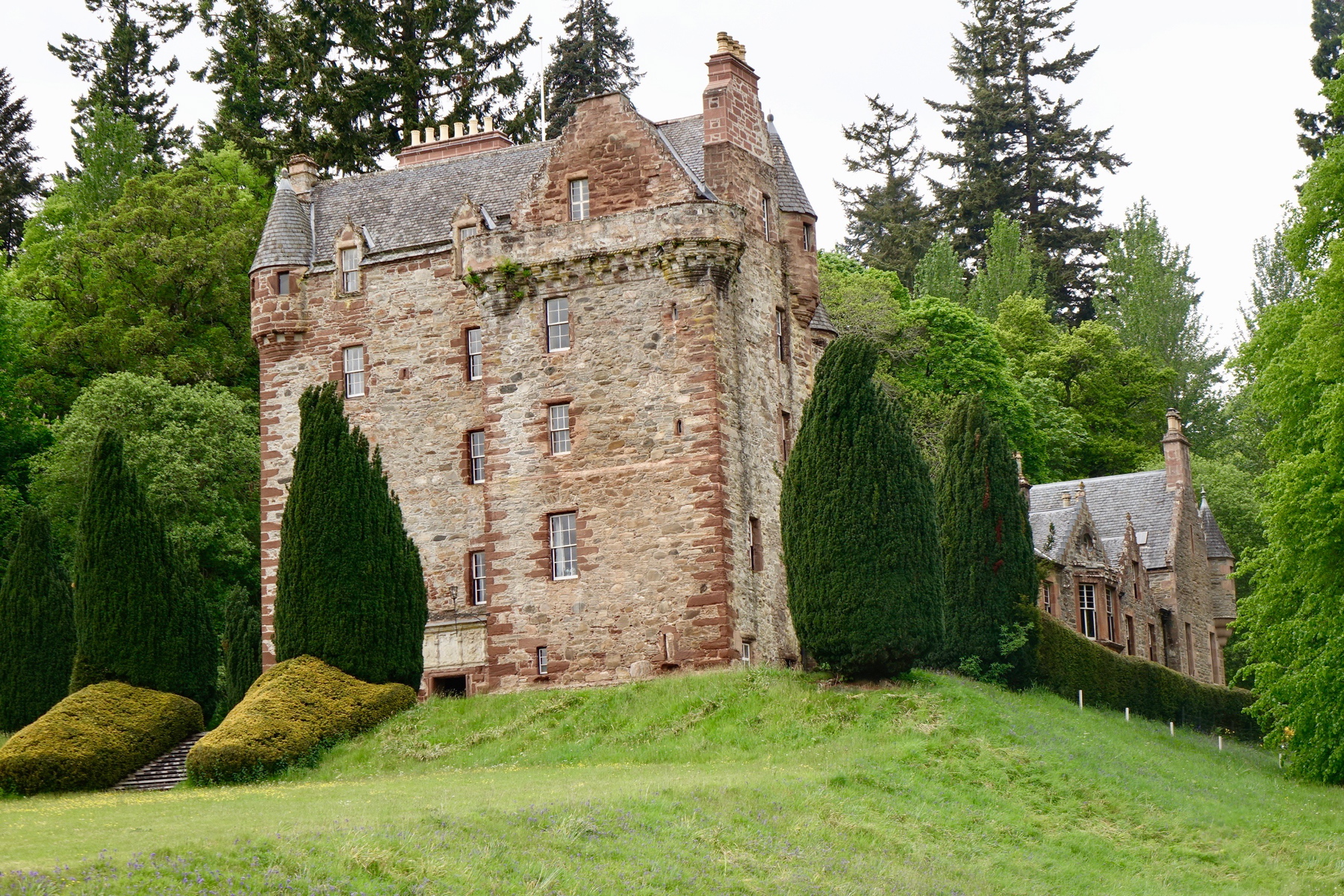
After Mary Queen of Scots officially granted the land to the Mackenzie’s, John of Killen became the first Clan Chief to live in Castle Leod. By the late 15th century the tower looked much like it does today with further alterations. The Mackenzie’s currently live in the addition on the back wing.

Leod was also the inspiration behind Castle Leoch the seat and home of laird Mackenzie in Diana Gabaldon’s fictional series Outlander.

Castle Leod

Castle Leod

Castle Leod, open only a few days a year, has a less imposing stature and a more intimate feel. My heart skipped as we walked up the long, tree-lined avenue to the castle. Above the front door, I admired the marriage stone dating from 1605 commemorating the union of Margaret MacLeod with Sir Rory Mackenzie famous ‘Tutor of Kintail.

Imagine my surprise when we opened the door and our clan chief John Mackenzie, 5th Earl of Cromartie, welcomed us as warmly as banquet guests. He showed us the sword rack and a tapestry of the Mackenzie family tree, and then led us to a stone stairwell to the Great Hall.

“The fireplace, still used today, and the frieze above it are originals,” a guide, explained. “Of course, the wood replaced the straw floor used back in the day.”

Decorated with Regency period furniture, cabinets held family heirlooms – letters, jewelry, medals and other memorabilia. Paintings of former clan leaders hung on the walls.

“Be sure to notice the a prie-dieu, (praying table) a gift from Mary Queen of Scots,” the guide said pointing to a 2-foot- high, structure with 2 pillars, “ Unfortunately no one has figured out how you could actually use it to pray.”

Off of the Great Hall, an Edwardian style Billiard Room, contained its original wooden pool table. The room also holds century old books crumbling behind the glass-enclosed bookshelves. A map on the wall of the estate surveyed by John Leslie in 1763 remains accurate still today.

A narrow staircase wound around to the ground floor to a hall with servant’s bells and speaking tubes. Off of this, steps lowered to a tiny dungeon at one end and to a large vaulted kitchen in the other.

“My father used this as a wine cellar,” John wrote, “but by the time I inherited the estate the only thing left down here was ghosts.”

Like every good castle, Leod too has ghosts. Footsteps of the chief ghost, The Night Watchman, can be heard wandering guarding inhabitants. The Sad Ghost haunts the dungeon. After dark, soldier ghosts eerily hover at the front door. Perhaps, they date back to the time the castle was confiscated after George; The 3rd Earl of Cromartie’s fought for the Jacobites in the Rebellion.

Spanish Chestnut tree

Spanish Chestnut planted 1553, oldest tree in the UK

The castle’s gardens held natural treasures like the giant sequoia, the largest tree in the UK. Two ancient Spanish chestnut trees, planted in 1553 commemorated Queen Mary of Scot’s land grant, remain the oldest trees in Britain. On part of the estate’s extensive parkland, bordered by the Peffery River, prizewinning Aberdeen Angus cattle graze.

In previous centuries, the Highland Clan leaders held power over life or death. The Hanging Tree for male prisoners stood in front of the castle and to one side was the Drowning Pond, where female criminals met their fate.

Clan Chief John Mackenzie

Clan Chief John Mackenzie with the author

Today it is hard to imagine our present clan chief John Mackenzie wishing anyone ill will. Before we left, he graciously agreed to pose for a picture with me. With good cheer and humility, he even grinned for the camera. But my smile was even greater for this special moment will be etched in my family’s archives forever.
I Declare Mackenzie Day to Celebrate My Heritage

Beauly priory

Beauly priory

On the east coast of Scotland, outside of Inverness, we traveled to the heart of my clan’s land and I declared it Mackenzie Day. We started out wandering among my dead ancestors in Beauly Priory, founded in 1230 as a Valliscaulian monastic community. Every other tombstone was engraved with the name Mackenzie, but the most poignant one lie in the north transept of the church.

“Sir Kenneth Sixth Barone of Kintail” was engraved in the border of a stone bed where a recumbent man with sharp chiseled, facial features, beard and mustache rested. Long arms and strong hands, once bearing heavy swords, lay idle at his sides since his death in 1491. Across from his grave lies the tomb of Alexander Mackenzie, who died in 1557, though his effigy is no longer intact.

Effigy of Sir Kenneth Mackenzie

Effigy of Sir Kenneth Mackenzie

From the beautiful village of Beauly, we drove down one lane backroads around Beauly Firth* in search of the Redcastle that remained in Mackenzie Clan hands until 1790. From here my 8th great grandfather Colin Malcolm Mackenzie, the 4th Lord Of Redcastle, traveled to America.

Redcastle

Redcastle, Scottish Mackenzie connection to America

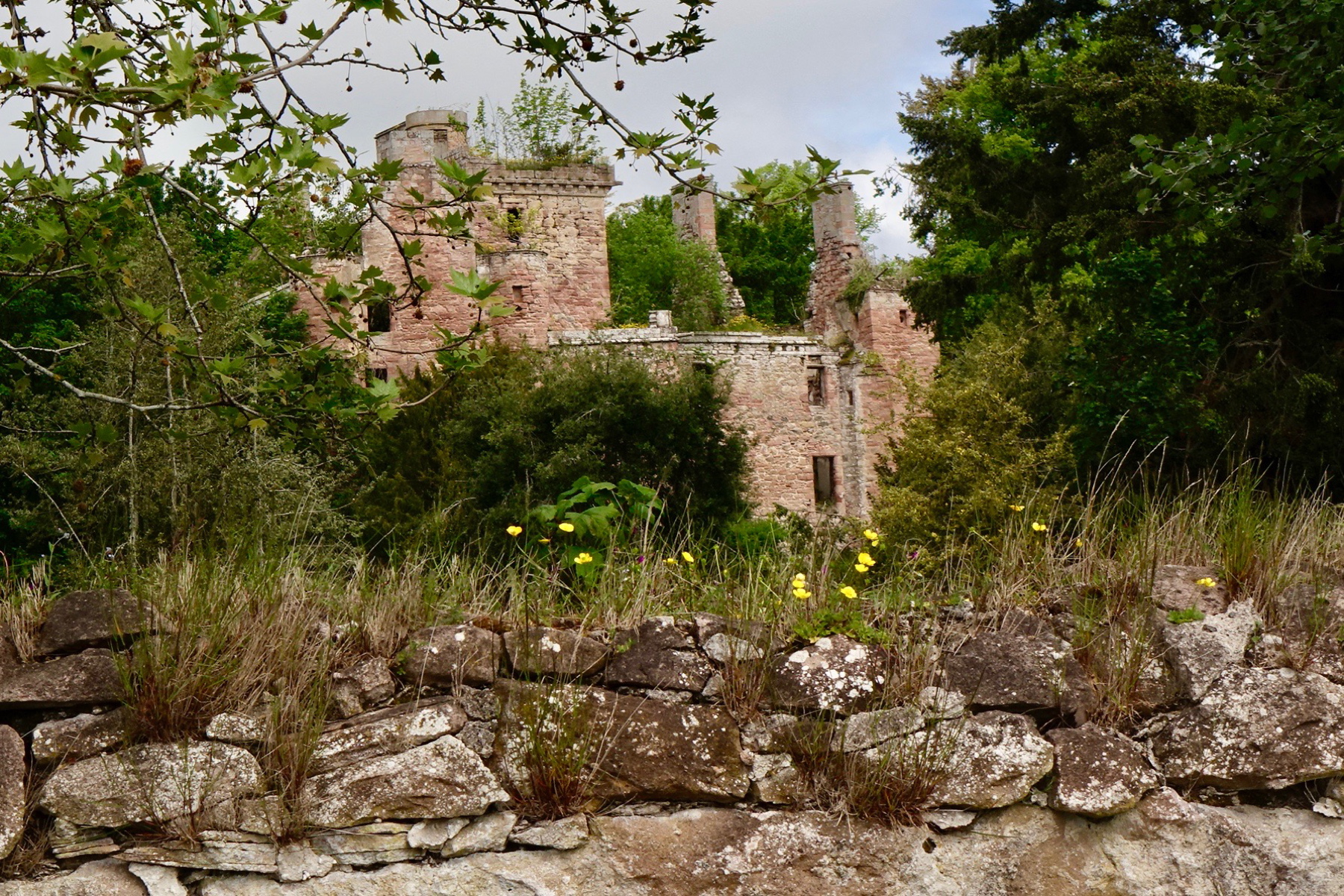
Finding the mediaeval Redcastle, historically known as Edirdovar, was a mystery. It’s marked as a dot on the map of Black Isle, a peninsula between Cromarty, Moray and Beauly Firths. We parked and wandered on foot trying to peek over the 6-foot high brick wall and finally caught a glimpse of the red stone remains. I found a path leading uphill behind a tree line and stumbled upon the crumbling walls of the Mackenzie fortress dating back to the 14th century.

Trees grew out of window frames, overgrown with shrubs and brambles. “No trespassing,” signs warned beware as bricks could tumble down anytime. Though the abandoned chateau was a far cry from it’s former glory, I felt like I discovered a hidden treasure. The castle itself had fallen into ruin, but the well-kept grounds of Redcastle held a working estate where horses grazed on a lawn that looked like a putting green.

In the afternoon we went to visit the Mackenzie clan seat at Castle Leod, which had been in the hands of the Mackenzie’s for centuries, and merits its own post to be shared next week.

Coul House

Coul House

To top off the day, we dined at the Coul House Estate where descendants of the Mackenzie family lived since 1560 until 2003 when the MacPherson’s purchased the mansion turning it into a hotel.

That evening on a hilltop overlooking Beauly Firth, standing in the ruins of Redcastle, I heard the footfalls of my ancestors. I listened to the night call of birds, while the sun set over my shoulder. Here in the shadows of my mighty forefathers, I felt humbled by the evolution of time, calm in the knowledge of life’s continuity.

I shared a profound connection to my ancestral land. A land of rugged mountains, jagged crags, moody moors and misty sea lochs. I sensed a feeling of coming home. Home to deep blue waters, green fields, dark forests, rolling hills and ragged coastlines. Home to a haunting land of castles and ghosts, clans and kilts, witches and magic, superstition and legend. Relentless winds. Stormy seas. Savage landscapes. Wild, wild like my restless soul calling me back to my people, back home to the Scottish Highlands and the Mackenzie clan.Firth in Scotland

*A Firth is a long, narrow indentation of the seacoast used to denote coastal waters in Scotland.

Visiting Cambridge Makes Me Feel Smarter

I went to Cambridge, the prestigious medieval university, only as a tourist, but boy did I get educated. Though my former students have attended these hallowed grounds, I felt like a dunce when I realized Cambridge was not one central institution, but actually 31 different colleges under the administrative umbrella of the University. The colleges, established between the 11th and 15th centuries, have unique, individual histories.

In 1209, after a dispute with the townspeople, scholars from Oxford University left and established Cambridge University 80 miles away. Today Cambridge is the second oldest English-speaking university and one of the top ranked institutes in the world.

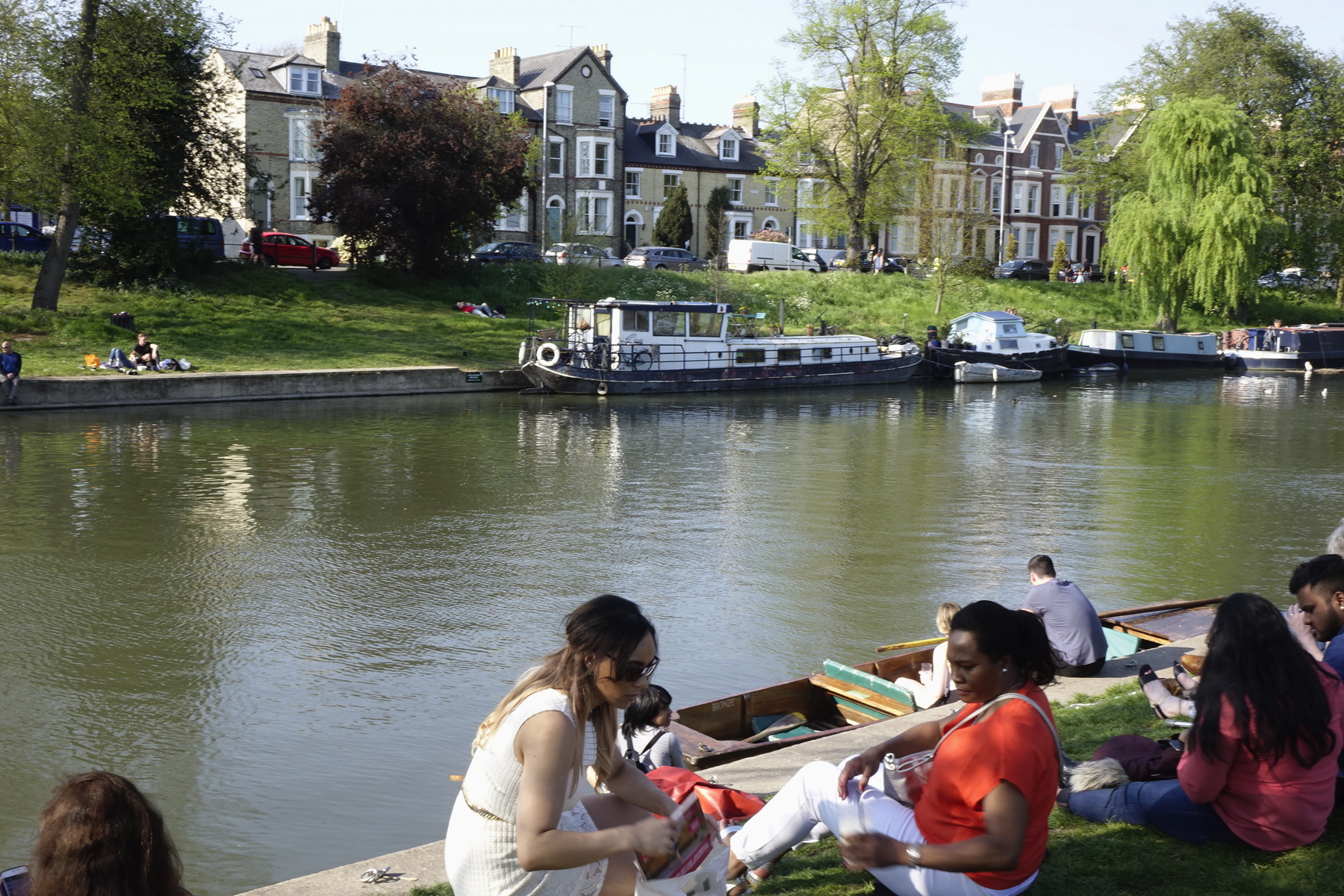
But a visit to Cambridge entails more than just admiring the stately architecture of buildings spanning over 800 years. Part of the intrigue includes people watching from outdoor café’s, pubs and eateries that line the streets and on the boardwalk along the River Cam. Or do like we did, bring your own picnic and head for the park to truly savor the show.

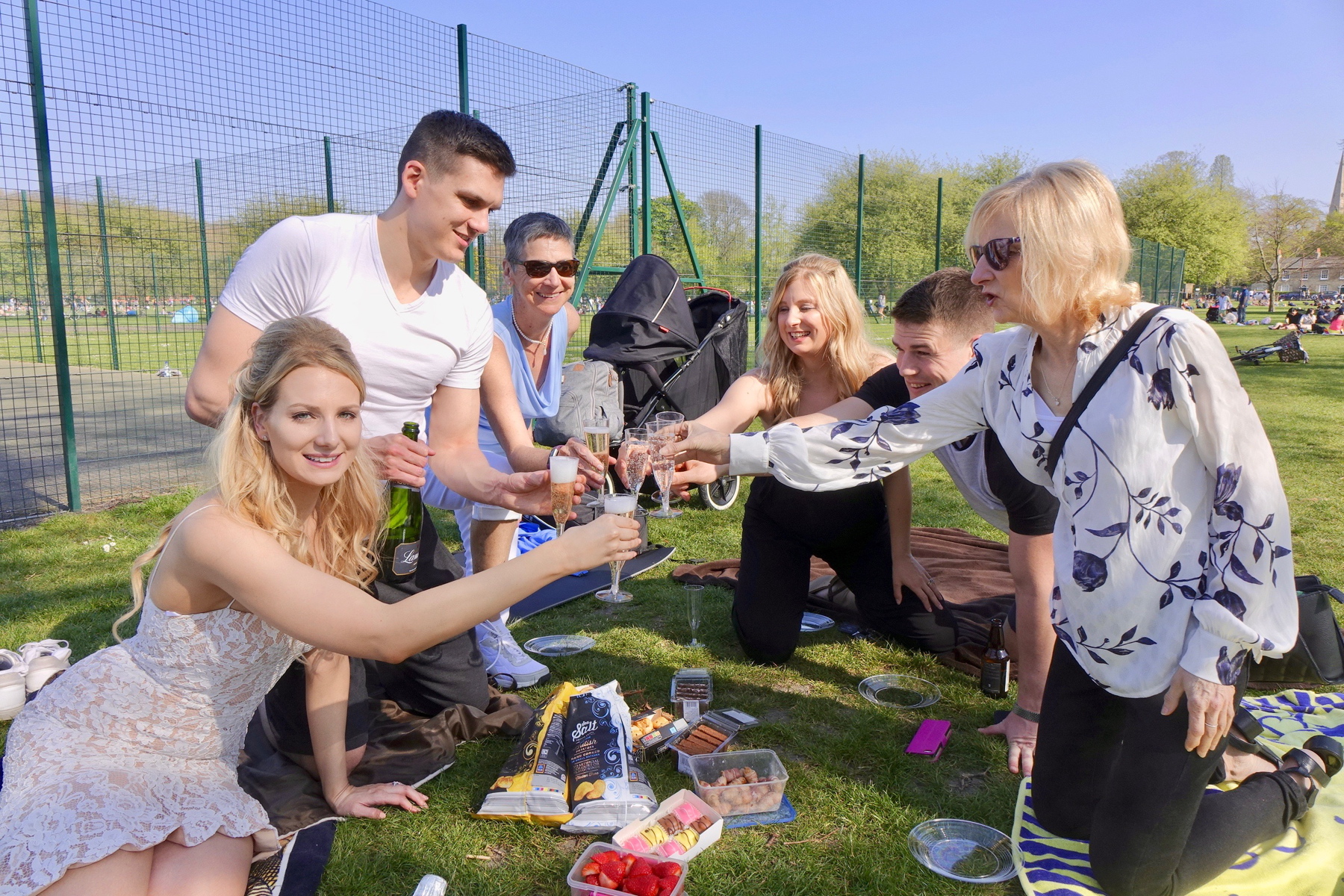
Under a shaded spot near the tennis courts of the central park, we spread out blankets, baskets and baby and enjoyed the beehive of activity on a gorgeous spring day, amidst co-eds, families and friends of all ethnicities.We popped a bottle in Charlotte’s baby’s chubby cheeks, unwrapped the grown ups’ goodies and toasted our son and his fiancée in an eclectic picnic. Pigs in a blanket, pork and cheese rolls, salt & vinegar crisps (chips) were followed by sweets – brownies, French cakes – pink, chocolate and yellow frosted squares and strawberries.

After hearty appetizers, we walked around Cambridge stopping to take photos of historic spots like the Round Church, a city landmark. The Church of the Holy Sepulcher, made of the same chalky limestone used throughout the city, remains one of only four medieval round churches in England.

Though this church is not affiliated with Cambridge University, the ecclesial influences can be seen in most of the old colleges, which boast of private chapels of architectural wonder.

The most famous, King’s College Chapel, is an example of late medieval architecture, and known for it stained glass windows whose refracted light creates incredible beauty under the vaulted ceiling. The chapel, a Tudor masterpiece, commissioned by Henry VII, was completed under Henry VIII reign.
Lady Margaret Beaufort, mother of King Henry VII, founded one of the oldest and largest colleges in Cambridge, St John’s, in 1509. Her crest appears over the main entrance to the college.

Peterhouse, founded in 1284, claims the title as the oldest college at Cambridge. Sidney Sussex College dating back to 1596 is the “youngest.”

Until 1869 Cambridge was only open to men. Girton College was founded for women in that year, to be followed two years later by Newnham. Churchill, Clare and King’s were the first previously all-male colleges to admit female undergraduates in 1972.

Cambridge’s former alumni include Sir Isaac Newton, Charles Darwin, Lord Byron, Stephen Hawkins and other Nobel Laureates.

One of my brightest former basketball players attends Cambridge and I look forward hearing what it feels like to graduate from such a famous center of learning.

As for me, I felt smarter just strolling the streets of town and walking in the footsteps of some of our world’s finest scholars.

Punting in Cambridge To Celebrate Special Occasions

When my son’s British fiancé told us we were celebrating their engagement by going punting in Cambridge, I imagined kicking the pigskin around a ballpark. But the English don’t play American football. Then I thought it must have something to do with rugby, as her brother-in-law is an avid rugby man.

Well, what a surprise! Punting has nothing to do with playing ball on a pitch (field), but instead involves a boat on a river.

Imagine skimming across the water in a “punt.” Picture a Venetian gondola that is shaped like a flat-bottomed, mini-barge.

In Cambridge punting along River Cam leads you past the famous colleges of the University of Cambridge. Founded as far back as 800 years ago, each contains its own history, architecture and stories.

The punt, dating back to medieval times, allowed navigation in shallow water areas. Until recently commercial fishermen used punts to work the fens of East Anglia. In 1870 punting for pleasure began, becoming more common in the 1900s and today is considered a part of the Cambridge experience.

A person navigates by standing on the till (known as the deck) at the back, not paddling, but poling. It looks easy. It’s not. Imagine trying to propel a dozen hefty passengers forward by pushing off the river bottom with a pole vault stick.

Poles, usually made of spruce 12-16 feet long, have a shoe, a rounded lump of metal on one end in the shape of swallow’s tail. Without a rudder, the punt is difficult to steer and the pole can get stuck in the river bottom.

Our next dilemma was who was going to pole the punt?

I assumed David would guide us down the River Cam, but sidelined by a rugby injury, he couldn’t even bend his knee enough to climb into the boat.

Fortunately Larissa and her sister, Charlotte, had the foresight to barter for tickets that included a guide. From the Quayside Punting Station near Magdalene Bridge, we clambered into the low seats of the punt.

Like a modern day Huck Finn, a handsome, young man in khakis and a white shirt stood in the stern grasping his pole. In the voice of a great orator, he recounted the history and legends surrounding the colleges of Cambridge during our 45-minute ride up one side of the Cam and then down the other.

“The Backs refers to a one-mile stretch past the rear sides of some of England’s most prestigious and oldest universities,” our guide said. “A few of the famous colleges, which we will be passing include Trinity College, founded by King Henry VIII in 1546; Trinity Hall, where scientist Stephen Hawking studied; and St. Johns College, which was attended by poet William Wordsworth.”

Along the riverbank people dined at outdoor cafes, college co-eds lounged on lush lawns under weeping willows and boatloads of tourists drank beer celebrating the arrival of spring. A carnival like atmosphere prevailed. Punting was like being in an amusement park on bumper boat ride and sure enough another boat slammed into our side, jarring my back.

While the skilled college guides maneuvered between boats, amateur punters spun in circles and crashed into other vessels.

“On your right is St. John’s,” our guide said, “one of the oldest and most celebrated colleges in Cambridge.”

As we passed under the city’s famous Bridge of Sighs, named after the one in Venice, the scene felt surreal.

When we opened champagne and raised our glasses to Nic and Larissa, I thought, what are the odds of small town girl from Illinois marrying a French boy from Normandy and raising a Franco-American son who’s falls in love with a beautiful English/Irish-Ukrainian girl.

How extraordinary the fate uniting our families as we celebrate toasting to their future by punting in Cambridge.

Staying at England’s Historic White Hart Coaching Inn

Staying at the historic White Hart in Ampthill, once one of England’s 18th century coaching inns, made me feel like I slipped back in time to the Wild West days à la European.

Before train systems developed, coaching inns served as a key part of the travel infrastructure in Europe. On overnight stops, stagecoaches stopped there to “refuel.” Weary travelers rested and ate and drank at the pub, while their horses were fed and watered in the stables.

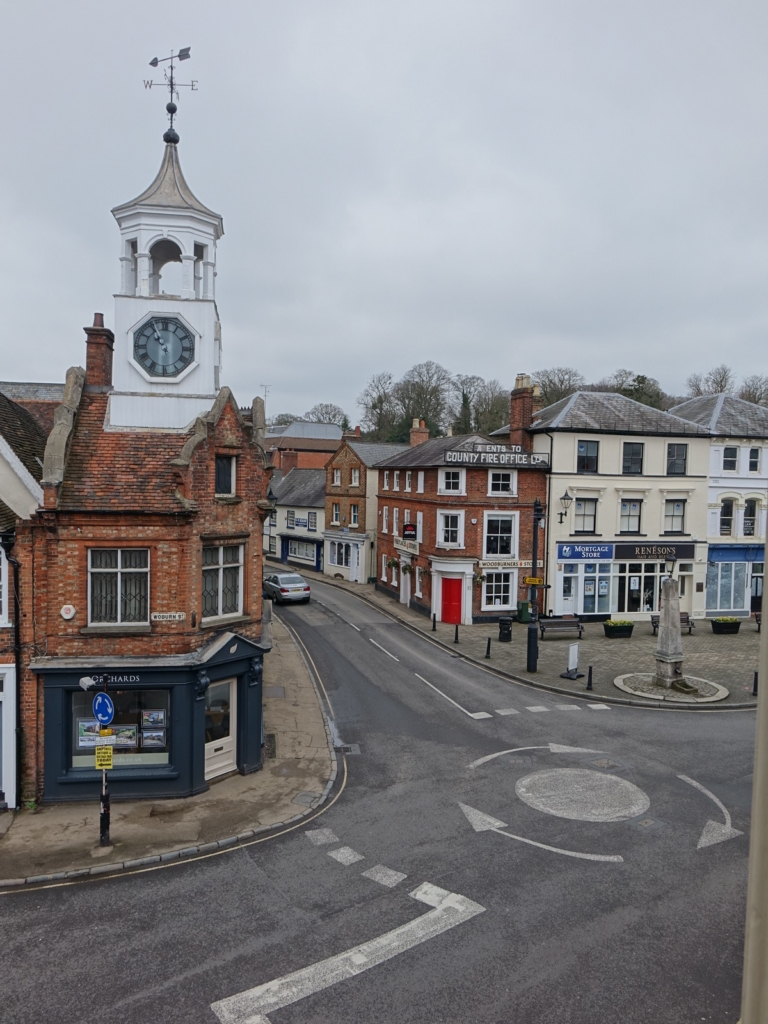
On the square across from the clock tower, the Queen Anne style White Hart, built on a Tudor foundation, remains the soul of the Georgian market town dating back to the 11th century. The hotel’s name, Hart, a term for stag used in medieval times, represented the most prestigious form of hunting. Royalty from London tracked these animals in the woods around Ampthill, a day’s carriage ride from the city.

The hotel, which over time withstood raids, conflicts and fires, has been restored in the style of an old coaching inn. The front door opens to the bar where cozy tables fill nooks like in a traditional pub, while the back rooms serve as dining areas. The former stables, now a dining hall, accommodate groups for banquets and receptions.
On the three floors above the bar, 8 refurbished rooms host overnight guests in modern comfort. To add to the charm each guest room bears a name representing someone from every century from the 16th to 20th.

Room No 3, the New York Chamber, honors Ampthill’s famous son Richard Nicolls, who was appointed by Charles II to reclaim Dutch settlements in North America for England. When New Amsterdam surrendered, Nicoll renamed the city and state New York in honor of the King’s brother, James Duke of York.

We stayed in room 7, the Inner Chamber, where wood beams added old world charm and the floor, which slanted toward the hallway, gave authenticity. I felt like I was on a ship as I stumbled to the bathroom in the middle of the night.

In the breakfast room, served in the Great Oak Parlor, once the former kitchen, you could savor a hearty English breakfast off the menu including the Full Monty.

No matter what time of day or night I walked downstairs to the ground floor, the place buzzed. Locals and visitors enjoyed their morning coffee, afternoon tea, an evening meal and favorite ales, which were once brewed on site. On a Saturday night, I could barely squeeze through the crowd at the bar to return to my room.

Being a guest at the White Hart Inn made me feel like I was living in another century. Stepping outside each morning, I almost expected to see a horse and buggy waiting on the square to squire me around the lovely English countryside.

French Mamie’s House in Trouville’s Historic Fishermen District

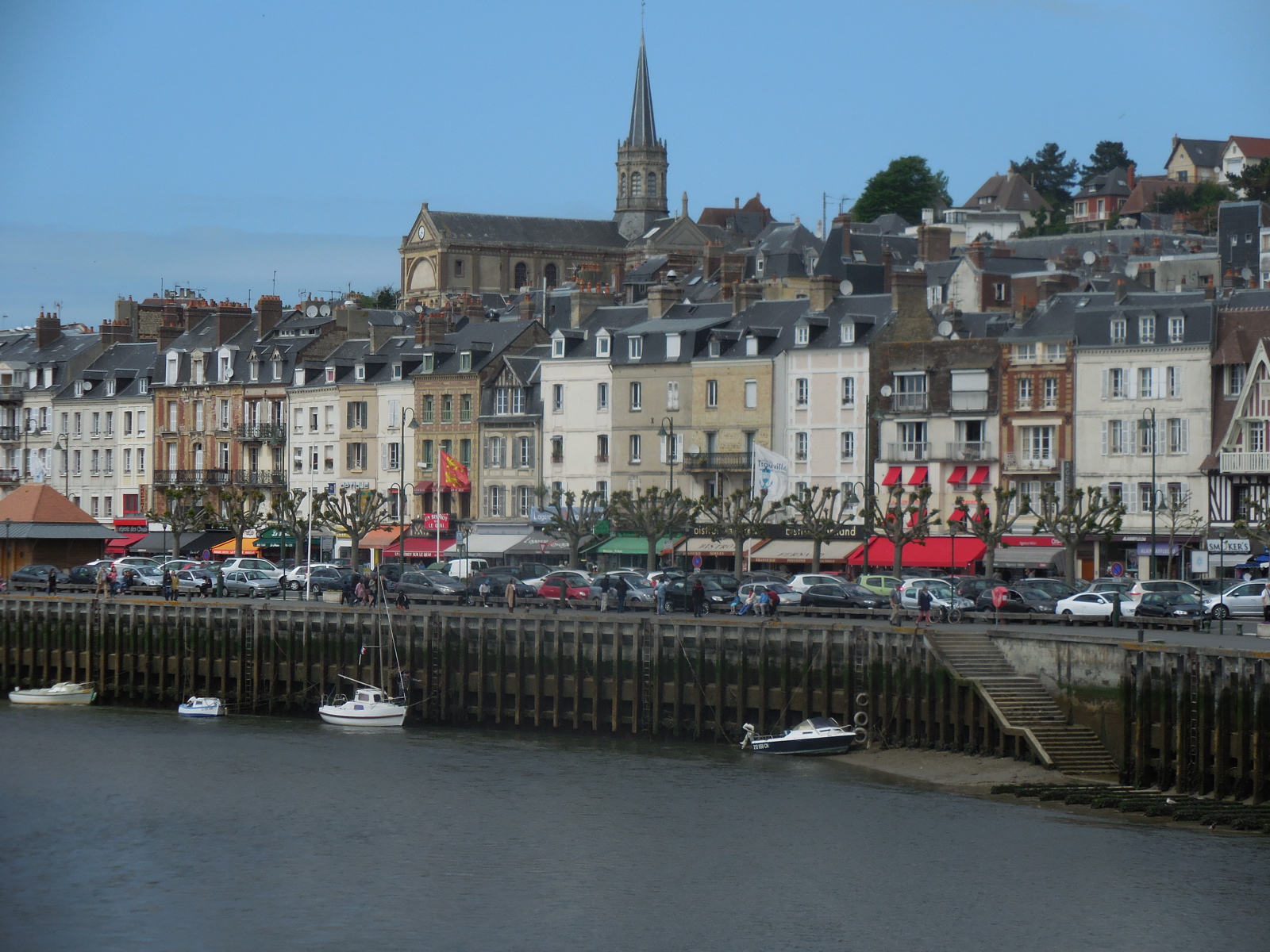
Mamie’s house overlooks the quay of Trouville, France, a fishing village where inhabitants exist in rhythm with the tides and the ebb and flow of tourists flooding her Normandy beach.

Mamie lives in the historic fishermen quarters on the Rue des Ecores, which dates from the mid 17th century when the quay was built. The houses once chiseled out of the cliff to accommodate fishermen reflected the maritime hierarchy. The sailors’ flats had one window and one floor, while the prosperous captains’ homes had windows on either side of the front door, and several floors.

The lower level of the building, filled with cafes, boutiques, and gift shops, opens to the bustling boulevard across from the open market on the Touques River. On the rue des Ecores up above, time froze; fishermen flats look the same as when they were first built. Wooden doors open to pencil-thin homes where rooms are stacked 6 stories high like building blocks.

On the narrow lane under number 55, the door opens into Mamie’s ground floor, which is actually the 3rd level of the building. On the left is her kitchen. Straight through the hallway to the dining/living area, French windows open to a balcony above the quay.

The windows on one side of the apartment face the colorful, lively, bright main street alongside the Touques River; the other side’s windows look onto the darker Rue des Ecores.

In the living room, a wooden dining table, the focus of any French home, consumes most of the space. A love seat, wedged next to the oak, Normand cupboard filled with Mamie’s old wedding china, faces the TV, perched in a corner. Though compact, the 10 x 14 foot room expanded to squeeze another chair around Mamie’s table where family and friends were always welcome to dine on Normandy’s finest fare from land and sea.

In between the two rooms, a steep, winding staircase, coils like a snake, from one floor to the next. The stairway is so tight that furniture had to be brought up by crane and passed through the windows.

On her second floor landing, there is a water closet and 2 bedrooms. In Mamie’s room stands a wardrobe of fine Normand craftsmanship passed down from ancestors. On the floor above that, are a bath and two more small bedrooms where we always stayed. Each morning I threw open the shutters savoring a birds eye view of the river, fish market, and casino. The very top floor under the mansard roof once held Papie’s old workbench and hanging tools.

Every nook and cranny remained filled with mementos triggering happy memories from Mamie’s giant dinner bell, to her French cartoon collection, to her lumpy, duvet covered beds. Artwork and photographs, showing the chronology of marriages, birthdays, baptisms, and graduations, covers every inch of wall space.

Whenever we left, driving away down Main Street, Mamie and Papie stood on the wrought iron balcony waving goodbye and blowing kisses.

The historic landmark, Rue des Ecores, endures as the center of the fishermen district, just as Mamie’s place remains forever as the heart of our French family.