




 Feeling old, achy and foggy brained? Experts say learning a new skill is recommended for our rusty bodies and aging brains. For me, relearning old skills is equally valuable. It is never more important than after suffering a traumatic brain injury (TBI) which can effect spatial awareness, balance, proprioception, executive function, listening, speaking and emotional stability.
Like so many people after injury, illness and accidents, I was forced to reframe my life. Once I retired from playing pro ball, I dreamed would learn to scuba dive, alpine ski and surf. I’d run marathons and bike mountains.
Well, that hasn’t been an option for decades.
So when my chiropractor in Geneva (Switzerland) suggested that I try “rope flow” to help strengthen my core, align my back, retrain my brain to better coordinate both hemispheres and work my lazy left side, I was all ears.
In Dr. G’s office, I watched in awe as he demonstrated swinging a heavy rope around his body.
“Jump rope sans the jump for injured adults!” I said.
“Actually, a heavier marine rope like sailors use works better,” Dr. G explained. “The sailboat boutique across Lake Geneva in Nyon carries all different sizes.”
Then he went onto explain the history.
“David Weck, an American, created rope flow to help people recover rotational movement and to reinforce how we walk, run and move. Rope wave, quickly adopted by elite athletes and movement coaches, has become a valuable training tool for improving mobility symmetry, coordination and striking power.”
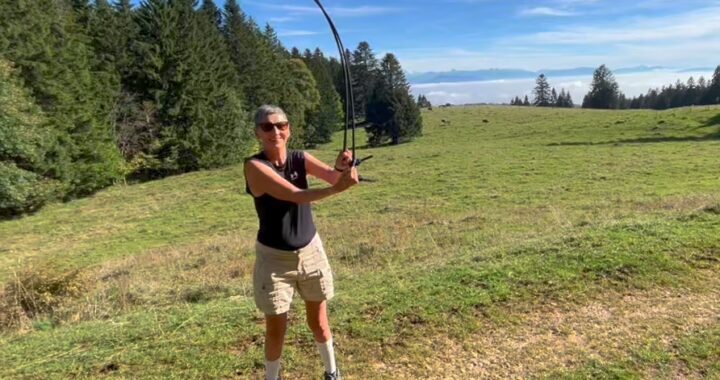
At first glance, rope wave looks easy. It’s not. It involves swinging a rope around your body in coordinated patterns like figure-eights, while shifting your weight and rotating your spine, shoulders, and hips with rhythm and control.
I was delighted to discover a game that I can play without getting hurt as long as I don’t whip myself on the back of my legs or lips.
If you perform rope flow properly, the rapid rhythm builds a smooth, effortless coordination across both sides of the body. Rope flow is symmetrical. You rotate both left and right, retraining your non-dominant side and this helps smooth out imbalances.

Rope flow is ingenious for its affordability, convenience, practicality and simplicity. This portable habit helps rewire the way I relate to my body. It is probably even more valuable for people like me who suffer from the effects of a stroke or TBI where message systems in the brain are damaged and to weakness on one side of the body.
After my time at the Functional Neurology Clinic in Minnesota, I learned how neuroplasticity allows the brain repair itself. After my brain surgery, messages did not get to my left side. Rope flow trains the brain and the body simultaneously and I would recommend it for anyone recovering from a TBI.
I am learning to accept my limitations, no more hooping, running, jumping. No kayaking, canoeing, golf, tennis, pickle ball or any asymmetric sport requiring lateral movement. For me, traveling in cars and planes or even sitting must be minimized.
So I was encouraged to finally find a sport I can perform with my broken body; it’s even good for me.
Granted I look a bit crazy, but who cares? I swing my rope, whistle like my dad used to, hang out with cows up in mountain meadows and admire the panoramic Alps.
It is highly unlikely that you can find an instructor in your area, but David Weck, Tim Shieff and other experts offer detailed videos breaking down movement into steps.
So pick up a rope, put on your favorite song and swivel those hips.
Yahoo! Clear the way! Look out! I’ll lasso you…my first dream was to be a cowgirl!

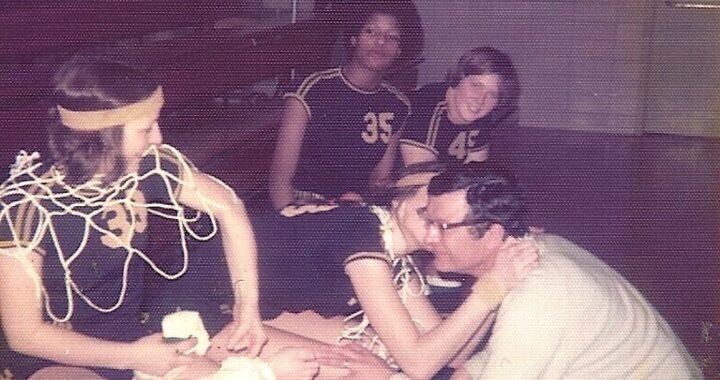
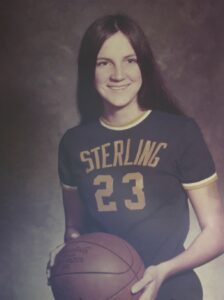
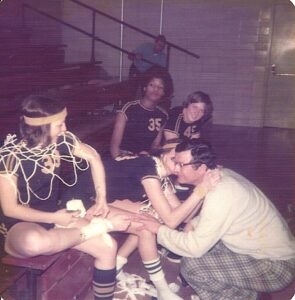 This weekend at my alma mater, Sterling High School Class of 1975 celebrates its’ 50th reunion. Sadly, the Big Pond and 4000 miles that separate us makes it impossible for me to drop in, but pieces of my heart never left home.
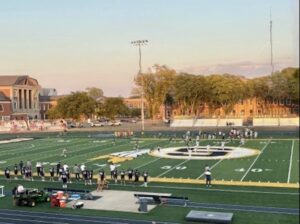 In the 70’s, our streets were safer; outside threats smaller. We lined up on the playgrounds during fire drills and hid under our desks in tornado warnings. But no one could ever imagine a school shooting.
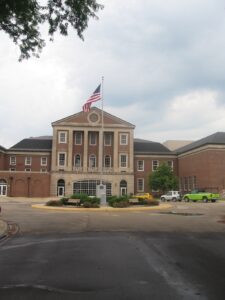 Back then, we walked through the open school gates freely. Now security guards check backpacks at the door and roam the halls sweeping lockers for guns. Active shooting drills have become the norm.
 Not right away. But when Title IX started rolling, we were one of the first schools in Illinois to provide girls’ competitive sport programs.
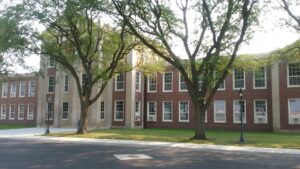 If we ever failed to toe the line at SHS, we had great character-building role models, teachers, coaches and administrators who held us accountable and made us own our mistakes.
 and other chronic diseases.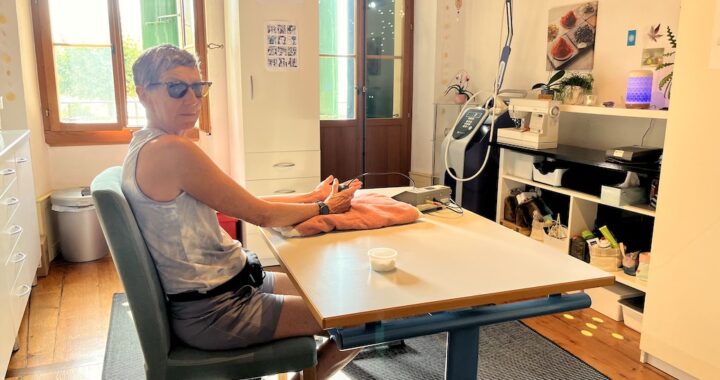
 I stopped blogging when overgrown connective tissue crippled my fingers from Dupuytren’s Contracture, a hereditary condition. A hand surgeon split my palm open, removed the diseased tissue and attempted to straighten my little finger. The dozens of ragged stitches across my hand healed, but on top of muscle memory, the tendons and ligaments pulled my finger back into a clawed position in a protective natural reaction.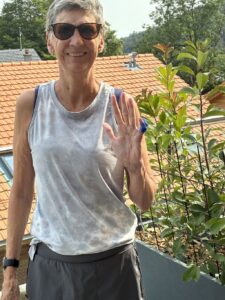
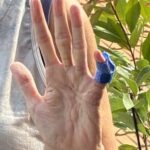 After a half a dozen visits, the ergo-therapist put my hand in thin, plastic glove and dipped it in warm, melted wax. Then she kneaded my palm and finger to break up scar tissue, restore mobility and coax tendons to loosen their hold on the joint.
 Lately, the medical field has been broadsided. Healthcare workers face endless scrutiny and skepticism under a tsunami of misinformation on social media and inaccurate directives from the authorities. That, along with major funding and resource cuts, make their job even harder.
 God grant me the serenity
 Have we forgotten our past?
 Yet as individuals, we remain impotent, helpless and hopeless. How can one human being, especially one with a broken body, ever change the world?

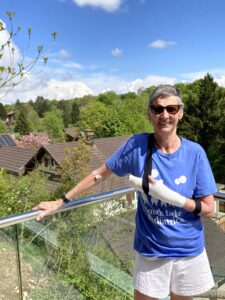 My old friends and teammates will remember my notorious feet with toes so crooked I could hang upside down by them. Back in high school in Sterling, Illinois my podiatrist, Doctor Heffelfinger, gave me my first foot orthoses. He also showed me how to tape each toe to prevent blisters from forming between my phalanges when playing basketball.
 When he described the complex dissection required to prevent digital nerve injury, it helped that he spoke English. He drew lines across my left hand and explained that he would cut into my palm to remove the chords in my palm and pinky. Unfortunately, my disease had advance too far for him to perform a simpler needle aponevrotomy.
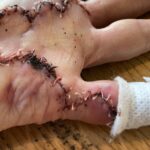 Dupuytren’s and the collagen had formed spirals around the nerves in the finger joint.”
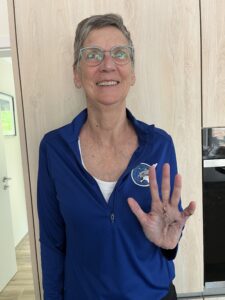 On the bright side, I retain bragging rights in my extended Olson, McKinzie, Lechault, Carlson, Miles, Westphal, Zhang family. I hold the record for the most stitches. It will be hard to beat!
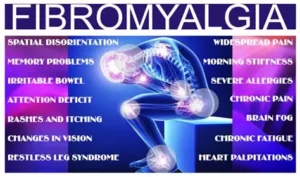
 system dysfunction. It impacts the muscles, and can lead to pain numbness, tingling, twitching, restless legs and osteoarthritis. FM also often includes other co-infections and immune system dysfunction, which is why it is paired with CFS.
 determined to raise a family, teach and coach kids to never give up.
 I am not a trained heath practitioner. I cannot offer medical advice, but as a fellow human being,