Living in Darkness Without Losing Hope

On, December 21st, the earth tilts farthest from the sun in the Northern Hemisphere. Ah, the gloomy gray Winter Solstice, the longest night of the year. No one knows as much about enduring dark days as my Norwegian relatives living on fjords by Narvik, near the North Pole. I, too, have learned how to live with limited light. For the past three years I have lived in darkness as I endure a medical treatment for a multi system, auto immune, inflammatory disease in which my body produces too much Vitamin D. I live in a house with lights off, my skin covered head to toe and hide behind thick black glasses. I lurk in the shadows, coming out at night like Boo Radley in To Kill A Mockingbird.

In one of my greatest moments of despair, I came to terms with the idea that we are all dying. Get over it, girl. As soon as we are born, our cells begin to decay. When I lament that I cannot ski the Alps, run marathons, travel the world as I so hoped after I “retired” from basketball, I focus on what I can do. I can write letters, give pep talks, edit English papers, encourage students, and offer support to family, friends and newcomers to Switzerland.

Right now as I write this, I am flat on my back, listening to my iPod, and typing on a laptop while resting the spine. This is not the life I envisioned. Oh no, I was going to conquer the world straight up. Even though I am often limited to my four dark walls, in a house shuttered closed like Fort Knox, I am amazed at how far the mind can wander. I can brush up on my German or French, strum my guitar, watch Macbeth, (ugh) take an on-line course, and write a blog.

Like a rapper without the bling, I walk to school in my hoody, shades and tennis shoes. Sometimes I lose my footing. But if Stevie Wonder could compose, “ You Are the Sunshine of My Life” and insisted “Don’t You Worry ‘bout a Thing,” in total darkness, I can make it through another day teaching with the lights turned low.

Everyday I gaze at the painting my dad made me of a lighthouse signaling safety from the stormy black sea. I focus on the pale reflection and pray for those struggling in the darkness; for my colleague suffering from depression, for my dad regaining use of his leg, for my buddy recovering from foot surgery, for a friend battling cancer, for all those people who are facing the loss of a limb, a life dream, a loved one, in moments of doubt and darkness.

Even though the blackness of longest night of the year seems interminable, I still have sunshine in my soul. And miraculously, the more I spread my light to others, the greater the hope, glows within me.

Snow Storms Leaves Passengers Stranded in Europe, Including Me!

Well, that was an interesting voyage. Round trip to nowhere. We left the house before daybreak and ten hours later, returned home in the dark again. We never left the airport, yet felt like we’d travelled for weeks. Since most European countries lack heavy snow removal equipment even a couple, little snowflakes creates huge havoc on the entire continent.

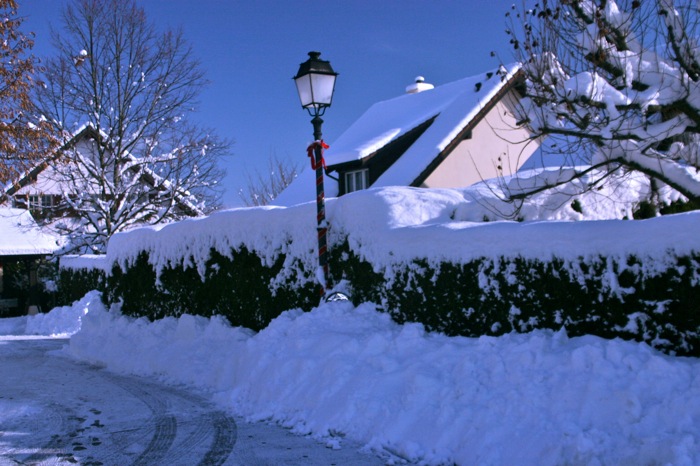
Lechault’s snowed in at home

First bad omen: our taxi got stuck at the stoplight at the corner of our street. While our wheels spun on a patch of ice, a Renault Scenic smashed into the back of a Volkswagen Passat at the adjacent stoplight. Fifty yards further, a Mercedes slammed into the stoplight on the overpass knocking out the traffic signals.

In bumper-to-bumper traffic, we crept toward the airport. As soon as we arrived at the check in gate, a voice announced on the public address system, “Due to inclement weather, the Geneva airport will be closed until further notice.”

Ever optimistic, KLM personnel insisted we check our bags and pass controls to wait at the gate, just in case. But as soon as the Geneva airport reopened, the Amsterdam airport closed. We counted as one after the other flights across Europe to London, Paris, Frankfurt, Stockholm, Madrid, and Moscow were cancelled on the departure board. Our flight was rescheduled for noon; fifteen minutest later the red sign popped up, “cancelled.”

Luckily, Geneva is a small airport, so I felt at home in what turned into a mini reunion of the international school. All morning, I chatted with a colleague whose flight to London was delayed. In the afternoon, I caught up with a couple of 12th grade students who were booked on that same ill-fated, KLM flight. We waited for rerouting in a line that crawled forward a foot every fifty minutes. After four hours, we finally reached the rebooking counter, and I offered hopefully. “We could fly to Chicago instead of Minneapolis.”

Fat chance flying anywhere. During the Christmas holidays, flights worldwide were over booked. Forty-five minutes later the airline agent suggested, “Sunday, we have space on a flight to Paris with a stop over in Washington, then Minneapolis.” I collapsed on the counter!

“Pleeeaaasssee, I have health problems, can you recheck for a more direct flight?”

By then, I looked like I rolled under a cement truck, so she searched the computer screen again. A half hour later, she found a Continental flight to Newark then on to Minneapolis.

Last leg, flag down a taxi and head back to our own bed. Passengers across Europe slept the night in the airports. Since snow is a natural phenomenon, the airlines aren’t responsible for providing meals or overnight accommodations. It could be worse. In light of everything else that could go wrong in life, it is ONLY a cancelled flight. And when it snows, it is best to be stranded at home.

After the taxi dropped us in front our snow covered house, I discovered students had left a bag of homemade chocolates and a bottle of wine on my doorstep. There is a God, after all.

Bonne nuit. But will I sleep? Yikes, in 48 hours, I am flying over the Atlantic again!

Escalade Celebrating The Pot of Soup that Saved Geneva

Sounds crazy, but the Genevians go gaga over L’Escalade, a tradition commemorating Madame Royaume’s famous soup that saved the city from the Savoyard invasion in early hours on December 12, 1602.

copyright Wikimedia Commons

Genevians held off the Duke of Savoy’s invading forces with a little help from a housewife. According to legend the night guard, Isaac Mercier, rang the church bells alerting the local militia. But the real hero was Madame Royaume, mother of fourteen, living above the La Monnaie town gate. She poured a pot of scalding vegetable broth over the ramparts. The heavy cauldron hit a Savoyard’s head, killing him as he was scaling the wall. The commotion spurred the residents to action. Tables, chairs and other pieces of furniture flew over the wall that night as the Genevians fought to maintain their freedom from Savoyard rule.

Every mid December, the quiet Calvin city comes alive in a carnival atmosphere like a giant street party. The event entails various activities, street artists and vendors serving mulled wine and soup at outdoor stands. Shop windows, decorated in Geneva’s colors of red and gold, are filled with chocolate cauldrons, symbolizing Madame Royaume’s marmite, filled with candy vegetables made of marizipan.

On December 4, the festivities kicked off with the 33rd annual Escalade Race where over 22,000 participants ran or walked four miles up and down Geneva’s snow covered, cobblestone streets.

copyright Wikimedia Commons

During the weekend of Dec. 10-12, the prestigious Companie de 1602, the society founded in 1926, organizes one of the most beautiful historic events in Europe attended by 80,000 visitors. The highlight of the fight for independence over 400 years ago is three-hour torch lit parade led where 800 members in period costume re-inact the scene in Geneva’s Old Town. Musketeers, pipers, horsemen, drummers are accompanied by fire crackers and gun salutes.

Though I have smashed open a chocolate pot or two as tradition demands, we never fully joined the festivity of throngs of people crowding Geneva’s streets. Yet, I can’t help but savor the moral of that little Swiss story. Supermom, Mom saves the day again.

Sad Day For Switzerland When Foreigners Go Home

copyright SVP-UDC

Switzerland the neutral, landlocked country at the heart of Europe is associated with chocolate, cheese, and cozy chalets but underneath this image of paradise, lurks an evil, ugly undertone.

A year after voting to ban the minaret, the symbol of Muslim worship, Switzerland voted for automatic expulsion of foreign criminals. After spending millions on racist posters promoting fear, the right wing SVP party won the campaign. 52.9% of vote and 20 cantons endorsed the proposal. Only six cantons voted against it and they were the French speaking ones, which many Swiss consider a separate country. Instead of hope, foreigners live in fear. Ironically, about 20% of Switzerland is composed of foreigners making up a work force predominately fueled by immigrants.

With illegal alien status in the past, I remember living in fear in someone else’s country. I have always been a black sheep. Pioneers live on the fringes of society struggling for acceptance in new roles. In 1980, as a 23-year-old, I emigrated to Europe for an opportunity then denied in my homeland, to play professional basketball. Since then, I have been at the mercy of foreign – French, German, Swiss – governments as an auslander.

Before marrying a Frenchman, I waited in long lines at city hall to renew my residency permit. I spent sleepless night worrying about obtaining a work permit, and then anguished over renewing it every three, six, twelve months depending on the laws of the country. Not allowed to sit on the bench, I instructed my French team from the stands when denied a coaching permit before legal matrimony. For years without work papers, I was paid “au noir” under the table for odd jobs.

Even today working and living in an international environment, not a day goes by where I forget that I am a guest in someone else’s country. As a white skinned foreigner, I no longer worry about keeping a low profile, afraid of being apprehended in Paris without the proper paperwork proving my legitimacy. In airports and train stations, I still feel anxious that I may be stopped and detained for some infraction.

But my fear is far greater for my darker skinned brother whose differences are more visible. Without steady employment, without family network, and without a Francophone spouse who can interpret the legalities and help fight for one’s rights and dignity, assimilation as a foreigner is difficult even in the best of circumstances. I chose to leave my homeland during a time when a career as a profession female athlete seemed like a frivolous pursuit, but even then, I never doubted, should my venture fail, I would always be welcomed back home. What about those who flee to survive, like political refugees and asylum seekers escaping from totalitarian governments and war torn societies? Or others like my grandfather who came to America in pursuit of a better life?

copyright Gérald Lechault (non SVP-UDC)

In the picture-perfect, postcard image of Switzerland, cows graze in green valleys where tidy villages spill out of a backdrop of spectacular white-peaked mountains. But underneath this placid scene, a storm is brewing. Is Switzerland as tranquil and tolerant as it appears?

Giving Thanks for Basketball

This Thanksgiving along with family, friends, and health, I am giving thanks for basketball. Thanks to Sterling High School, Illinois State University, UW-Stevens Point, the first women’s pro league WBL, International Basketball Association FIBA , and all the other high school, colleges, international clubs and federations that granted women permission to play basketball. Because it wasn’t so long along that girls were confined to the sideline.

Sterling Daily Gazette 1977

I am thankful for Jim McKinzie, the first man convinced I had the right to play. He taught me how to dribble and shoot before a time when dads and daughters playing ball together was apropos. In 1977, he coached my younger classmates and sister, Karen, to Illinois’ First Girls State Championship as co-coach of the Sterling Golden Girls. That first tournament was played at my alma mater Illinois State University where I earned the first college basketball scholarship, playing for the woman who first proved that a women’s heart wouldn’t explode by running fullcourt. God bless Coach Jill Hutchinson. And Shirley Egner, once a rival of mine graduating from UW-LaCrosse, making her mark as DIII national championship coach, who thirty years later shaped my daughter as an athlete at University Wisconsin Stevens Point.

Coach Hutchinson, Coach Egner & Nat

I’ve never been back for an ISU alumni game nor experienced the thrill of playing at my college alma mater in the Redbird Area in front of 10,000 fans. I’ve never even had the honor of racing down that polished wooden floor on my own highschool gym. In my day when girls were finally granted permission to play, we were relegated to the junior high gym.

I spent the first decade of childhood fighting to get on the court, the second decade playing the game, the third coaching competitively abroad, the fourth writing about the sport and the fifth feeling grateful that one day forty some years ago, somebody under my roof in my community, at my college, in my country gave me – a girl – a chance to play a man’s game. To gain that opportunity at that time was a battle; many people fought it every step of our way.

This Thanksgiving weekend, Sterling High School celebrates its first alumni basketball game. I wish I could be there, not to hit jumpers – my playing days ended long ago – but to give thanks. Over a century ago, James Naismith invented the game to bring people together and sent it traveling round the world with the missionaries he trained. I did my own small bit coaching internationally uniting high school players from all four corners of the globe. From starting the first girl’s basketball camp in Sauk Valley to initiating the first alumni game at the International School of Geneva, my life has been about taking the opportunity people gave me and passing it on, so that nobody grew up feeling second best.

This T-Day, no one thinks twice about girls getting sweaty, knocking down treys and going coast to coast. Nowadays, women would never consider blessing the gift of the game along with the bird. Equal opportunity in sport and education is a given. But today at my table, I’m taking time to thank the people who paved the way. Hallelujah, the chance to play ball is a birthright. Even for the female gender. Amen.

Beaujolais Nouveau – Wine, Music and Fireworks

According to my Frenchman, Beaujolais (BOE zioh lay) Nouveau is not a wine, it is an event. Any wine connaisseur will agree that when it comes to wine, older is better than new. The process used to harvest the Gamay grape, involving an expeditious harvest, a rapid fermentation, and a speedy bottling, may be likened to the « fast food »of French viticulture.

Beaujolais Nouveau, a young wine, only six weeks old, should be drunk before May unless it has been exceptional year like the harvest of 2000.

Beaujolais’ marketing success, is in part due to the government stipulation that the first bottle be uncorked on the 3rd Thurs of November. The race to be the first to serve the new wine begins as millions of cases are delivered to final destination by every means available, motorcycle, balloon, truck, helicopter, jet, elephant, runners and even rickshaws. The Japanese, traditionally not big wine drinkers, love this light, nectar. Beaujolais Nouvea is sold in 110 different countries with Japan being the biggest consumers, followed by the USA and Germany.

Wine shop downtown Beaune

Four thousand grape growers cultivate the region of Beaujolais, which is 34 miles long and about 8 miles wide, just outside of Lyon, France’s 3rd largest city. These are the only vineyards, other than the champagne region in central France, where it is in mandatory to harvest the grapes by hand. Sixty-five million bottles, half of the regions total annual production making up one third of the regions entire crop will be sold as Beaujolais Nouveau.

Throughout the world, traditions have developed to celebrate the release of the Beaujolais. The biggest is a three-day party called Sarmentelles, which takes place in Beaujeu, the capital of the Beaujolais region. The festival is named after the French word sarments, which are the cuttings from the canes of grapevine that are burned in town on the eve of the unveiling. Lyon hosts a Beaujolympiades with two days of wine, music and fireworks. Across France, local shops and grocery stores offer a sample sip in shot glasses. Even in the Windy City, chic restaurants celebrate the wine’s arrival in places such as the Chicago Sky Lounge, Bistro Zinc, and Bistro 110.

This light bodied, fruity wine appeals to many Americans’ palates. Since it arrives a week before Thanksgiving, expats abroad often serve it with holiday meal, but not in my house. My husband, appalled that the sacred turkey be accompanied by lackluster wine that is more about marketing than quality, insists on serving the T-bird with only the finest aged Bordeaux.

French law adds to the hype by mandating not one drop may be poured until a minute after midnight am on Nov. 18th. Banners in shops, restaurants, and pubs proclaim, “Le Beaujolais Nouveau est arrivé!” (New Beaujolais has arrived)

Every November 18th, though my husband is not a Beaujolais Nouveau fan, we uncork a bottle to commemorate a momentous occasion in our family. Twenty years ago, we announced to the world, “le petit Nicolas est arrive!” So I raise my glass to our son, “Happy birthday, Nic, santé!”