This Holiday Season Take Time to Play

ChristmasAfter the Black Friday blitz, which surprisingly arrived in Europe, even though Thanksgiving doesn’t exist here, I wonder if anyone else longs for that era when gifts were simpler and often times homemade? Back in the good old days when even adults took time out during the holiday season to play.

Can you remember your favorite childhood Christmas present?

I still cherish Christmas as a six-year-old: my big brother got a stamp collection book, my middle sister a fashion doll, my little sister a Barbie doll case, and I received a pop rifle.

ChristmasThough I may be an anti gun advocate now, back then a toy rifle meant that my family accepted gender equity long before society got around to it. My parents let me be free to play cowboys and kick ball. If I ever wanted I could also play dolls with my younger sisters.

Unlike the electronic games of today, our toys of yesteryear were designed to encourage social interaction, develop creativity and inspire make believe. They taught children how to share, to take turns, to cooperate and to help each other.

How different from the expensive Santa’s wish lists of today with things like Costzon Infrared Remote Controlled Robots, Electric Dog BeatBowWow Interactive Learning Toys, Self Balancing Electric Scooters, Xtremepower Hover boards and LovaBella Baby Dolls that can recite a hundred words and mimic their owners actions.

What does that leave to old-fashioned imagination?

ChristmasIn the 60’s my siblings and I invented games around the Christmas theme. We set up present wrapping stations and cookie baking shops. We enacted mystery stories by pretending to steal “magic” light bulbs from the Christmas tree.

We spent entire days setting up our Lincoln logs, dollhouses or train sets.

We loved it when three generations sat around the kitchen table coloring, drawing or playing cards, especially when Grandpa Mac tried to get our bluff.

Have we lost our ability to play?

Wouldn’t it be more rewarding to engage in a game with a human being instead of an activator?Christmas

As the holiday season arrives with the usual media fueled, materialistic commercialization, find a way to curtail the frenzy, to roll on the floor and wrestle around with your kids.

Take time out to play. Have a pillow fight, a tickle fest, a story swap.

Play an antique game of Twister, Clue, Monopoly, Life or Mouse Trap.

Turn off computers, cell phones, electronic games, tune out social media and focus on family and friends.


Have Yourselves a Merry Little Christmas.

YouTube player

Slow down, step back, savor the season. Have fun! I’ll be back in 2 weeks.

British Life Begins and Ends at the Pub

On a recent visit to England I discovered that British life begins and ends at the pub. The centuries old custom of pub going means more than frequenting the local watering hole where you can wet your whistle. The pub, a center of community life, is a place where social barriers break down, class distinctions disappear and everyone is treated equally. Even dogs.

Visiting a traditional pub with a native helps you interpret the pub going protocol. We would still be waiting to be served if it weren’t for Larissa our son’s British girlfriend. When she took us to her hometown favorite The Embankment, a trendy place in Bedford, she explained that you must go to the bar to order and pick up drinks.

This renovated, wood-timbered Victorian era pub built in 1891 across from the River Great Ouse down from the Rowing Club reflected its roots. Though it retains its old world charm, there is nothing stuffy about this place. Divided rooms cater for dinner parties and crowds, but the heart and soul of the establishment remains the front room’s long wooden bar.

A local patron, a jovial mate stood there reading a newspaper knocking back his first beer at 10 am. He greets the steady stream of clients by bending to pet every pooch that entered the premises while his own dog dozes in a stuffed chair by the door.

The family friendly pub welcomes kids and pets. Everyone can lounge around over breakfast, lunch or dinner on cozy banquettes and sofa chairs in front of a log fire. The din of adult’s chatter, children’s laughter, and dogs’ barking, creates a convivial carnival like atmosphere.

“It is the opposite of America,” my Frenchman quipped, “In England dogs are welcome, but no guns allowed.”

With people watching at a premium I reveled in the view. At the round table next to ours, a posh couple coddling a poodle ordered a morning whiskey and Baileys on ice with a side of coffee. I nudged my husband and whispered “They brought dog biscuits in a mini Tupperware.”

“That’s nothing,” Gérald said. “The local chap at the bar has a box of kibble that he hands out to visiting pets.”

For the price of a drink you can linger and savor the show all day.

After our morning coffee, as soon as a table freed up in front of the fire, Larissa ushered us to comfier seats where we ordered lunch. The menu? What else – fish and chips. In keeping with British tradition, we doused our thick-cut fries and fried cod with a dash of cider vinegar.

But by far the biggest celebrity to parade into the pub was Guinness, Larissa’s sister and brother-in-law’s dog. The fluffy, black labradoodle stole the show when he loped in on gangly legs while everyone cooed in delight.

Dining on fish and chips in a real pub made us feel ever so British. In addition to greeting new arrivals, the man at the front of the bar put a fresh log on the fire as soon as the flame grew low. As if we were royalty sitting in his front parlor, he shared a kind word with each of us on our way out.

We felt like honorary guests in a British private home… until it was time to pay the bill.

Flying Uneasy on Low Cost British Easy Jet

Easy Jet planeNothing easy about so called “Easy” Jet the low cost British carrier, which offers services on over 820 routes in more than 30 countries. For years my UK colleagues raved about the simplicity and affordability of Easy Jet. We wanted a quick, cheap ride across the English Channel from Geneva to London Luton Airport to visit our son who moved to the Bedfordshire area. After 4 decades of globetrotting, I have never had a worse flight. If all goes well the flight takes about an hour and 20 minutes. Alas if all goes wrong it can takes days.

Before leaving our house we saw on-line that the 20:15 flight was delayed an hour and 15 minutes, which for Easy Jet seems fairly standard. Nevertheless, the message from Easy Jet stated that we must come at the normal time to the airport to check-in.

Our family’s previous experience with Easy Jet made me shudder. One time our son’s flight was delayed twice, then finally cancelled at midnight. The Easy Jet personal told him, “So sorry mate. Can’t help. Give the airlines a call and they’ll sort you out in the morning.”

Eventually they stuck him on a flight from Zurich, which is two hours away by train. Then on his return flight he was stranded in Luton, which is ranked as the UKs worst airport in the city considered the “armpit of England.” When Easy Jet changed his booking, they canceled his return by mistake, so his ticket was no longer valid. He had to fight to get another ticket issued for free for the same day, but 10 hours later!

flight information boardBack to our own saga. By the time we arrived at the Geneva airport, our flight had been delayed another 25 minutes. Finally around 9:30 they announced our boarding gate, a bit earlier than the expected delayed time. From the gate they herded us into a bus like cattle off to slaughter. The bus lurched forward and backed into a terminal parking space a hundred yards from where we left. We stood in the bus waiting for another 15 minutes, then re-entered the terminal again to finally proceed to the boarding ramp. The plane finally took off 15 minutes later than the delayed time. Are you still following?

Departure from our home in Geneva – 6:45 pm; arrival hotel outside of Luton using the unreliable train system – 2 am. Travel time 7 hours. With a good tailwind, it would have been faster to fly to Chicago.

For our 6:15 am return flight on Monday morning, we left our hotel at 4:15 to arrive on time. A sign said that the boarding gate would be posted at 5:40. It was and they simultaneously announced “Last call boarding call Easy Jet Flight 2049 to Geneva; we will be closing the gate”

One minute we were sitting in Starbucks stalling and starring at the departure screen and the next instance we were racing through the terminal knocking over other frantic passengers rushing to catch the Geneva flight before it took off, which by the way left 5 minutes ahead of schedule.

Ah Easy Jet, the single class, high-density layout airbus, guarantees discomfort.

Imagine squeezing into an egg carton. You must fold your body into an egg shape for the duration of the journey. Seats, which feel like benches, won’t lean back even a centimeter; if you are tall tray tables rest on your knees.

To further curtail costs, Easy Jet discourages checked baggage by charging as much for a bag as you pay for your ticket. Nor does it offer complimentary food or beverages not even water. Purchases from Easy Jet Bistro buy on board will be expensive.

In spite of the inconveniences, Easy Jet fills 92% of its flights, so your plane will be packed even at 6:15 am. Oh those poor souls commuting to work via Easy Jet.

The cabin crew, the only saving grace, will be kind as if they spent a lifetime calming irate passengers who have missed connecting flights, important business meeting and special family occasions.

Saving money may not be worth the trade off due to the toll an Easy Jet flight takes on your body.

My recommendation: if you see bright orange Easy Jet label – run.

Unfortunately I cannot heed my own advice. If we want to visit our son and Larissa we have to fly Easy Jet. London Luton, 35 miles north-west of Central London, is Easy Jet headquarters and the airline is the only one offering a direct flight from Geneva.

Before I go back for another visit, I will consult my British friends and find out the insider secrets on the most painless way to survive a flight on the so called Easy Jet.

Explaining Thanksgiving to Europeans

Americans know the story of how Native Americans saved Pilgrims from starvation back in 1620 by teaching them to tap maple trees, plant corn and fertilize soil, but I have been trying to explain Thanksgiving to Europeans for decades. They remain bewildered by our Thanksgiving, a journée de remerciements. They think it is the only day of the year where Americans prepare a hot meal and eat slow food.

Decades ago when I moved to Europe, I was a pilgrim at the mercy of my French teammates who taught me their language and customs.

A year later, I became indebted to German friends who shared their homes and meals. Accepted by marriage into my French family, adopted into Swiss culture where I now live, I have always been a guest in someone else’s country.

Yet I remain loyal to my roots. Though every feast I have prepared has been a fiasco, Thanksgivings with my Franco American family has always been sacred.

“Are any European celebrations similar to Thanksgiving,” I once asked my husband. He looked at me incredulous.

“Of course not,” he said. “Native Americans are the only people on the planet gracious enough to thank their conquerors.”

No matter what the circumstances or who shows up at the table, T-day is one tradition I cherish.

My first year abroad I invited French teammates to dinner and much to my chagrin they ate the meal in courses, one dish at a time. The next year in Germany, the team turnout was so great, there was standing room only; we never sat down to dine.

When I introduced the custom to my French family, my mother-in-law served raw oysters first and insisted a turkey was too big; chicken would suffice.

If left to their own devices, Europeans could butcher our day of thanks.

What American celebrates Thanksgiving by eating an seven-course meal standing up? Who replaces Tom Turkey with Chicken Little to eliminate leftovers? Leftovers are Thanksgiving.

Born in the Land of Lincoln, I consider it my patriotic duty to give thanks on the fourth Thursday of the month, the day Abe appointed as a national holiday in 1863 when he gave gratitude for an instrumental Union Army victory at Gettsyburg.

Expats everywhere create their own special ties to their heritage.

When my Norwegian grandfather immigrated to America, he insisted on keeping the Norwegian tradition of eating lutefisk and lingonberry on Christmas Eve.

“My dad brought strangers home to dinner,” my mom said. “He’d say ‘so many people helped me when I arrived in the United States, I want to return the favor.’”

Every Thanksgiving, I gather family, friends and “foreigners” in a feast honoring my Norwegian ancestors, my American homeland and my host country. To avoid offending guests, I whisper thanks to the Great Spirit who watches over all of us regardless of our religious, national, or ethic affinity.

Apparently, like our Native American friends, she sees the good in man, even in the conquistador.

6 Lessons Learned From Old Inner Tube

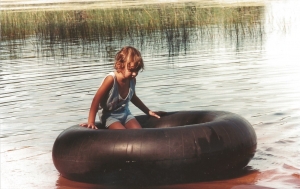
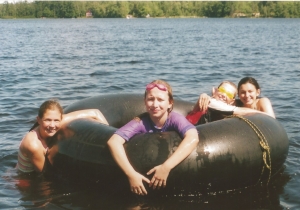
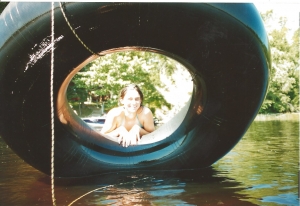
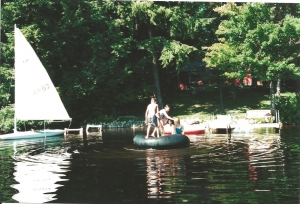
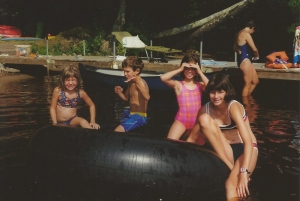
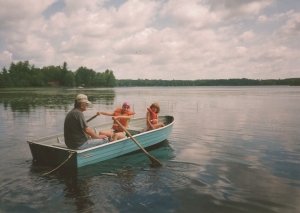
Our single most valuable educational toy was an old inner tube tractor tire that taught 6 valuable lessons and helped raise kids on Summit Lake. Like my siblings and me, my children and their cousins drifted through every stage of childhood floating on that old black tube. Society keeps inventing more high-powered vehicles and electronic toys, but what kids really need is non-motorized, unstructured downtime to be bored and learn how to play.

Kids need non-micro managed moments to be kids. To sky gaze. To float. To doze. To drift. To dream.

That patched up piece of rubber provided endless hours of entertainment. It kept us adrift through the stormy waters of life by creating happy memories to sustain us during hard times. We passed on the art of living in the moment from one generation to the next.

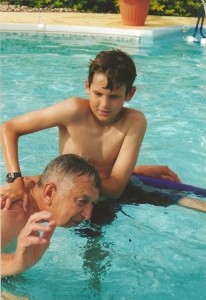
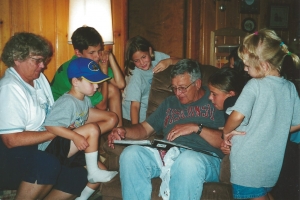
On the water, we learned to share and take turns, balance and agility, team building and muscle making. Off the water that old tube taught us to slow down, relax, and savor stories. While grandma read a fairytales or grandpa recounted sagas of the Summit Lake ghost, kids perched on the side of the tube and learned to love stories.

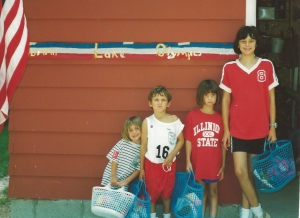
Creativity. That old tire sparked their imagination. They once invented a new sport, Tubastics, which consisted of bouncing on a tube in the yard and jumping up off in perfect 10 point landing. That event inspired their first Summit Lake Olympics complete with an opening parade, special events, posters, prizes, and spectators.

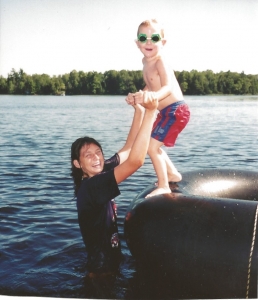
Courage. Younger kids learned bravery by holding hands of an older cousin and jumping off the side of the tube into the dark, cold water.

Leadership. Older kids learned responsibilities by helping younger ones learn to jump, swim, and dive.

Balance. In a sequence of challenges, they tested their dexterity.

  • First step – standing alone on the tube.
  • Next test – balancing upright holding hands with a partner.
  • Add another cousin.
  • Plus a friend.
  • Grand finale – a big splash as the lake echoed with laughter.

As teens and young adults, their games required more skill. Pass and catch while standing on tube became a favorite. Then pass and catch in air while jumping off the tube was added to the repertoire.

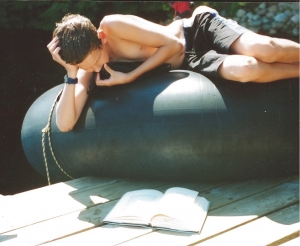
Love of books. On windy days, when the tube absorbed heat from the sun it was warmest spot on the dock and perfect place to read. From Bernstein Bears, to Death on the Nile, from Harry Potter, to Lord of the Rings. Minds enlarged with one mystery after another. Story after story.

Peace of mind. Kids float through summers chilling out in quiet moments of stillness on a silvery lake that rocks in a crib of evergreen under powder blue skies.

Children grew up daydreaming about the doctors, nurses, teachers, engineers, coaches, and counselors and high-spirited, nature loving, compassionate adults they would one day become. Every summer we drift back in time releasing that inner child in a state of mindfulness.

Yep, blissed out on that black inner tube.

Happy 4th of July!

Happy Father’s Day Man with Heart

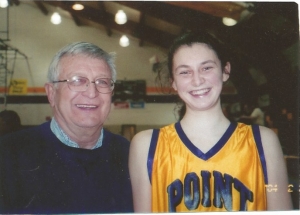
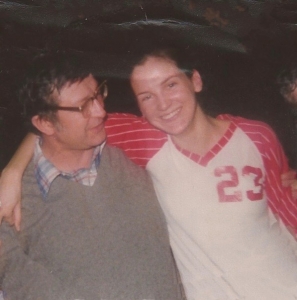
Though a pacemaker helps your heart keep its beat, we know it needs no assistance in applying its love to being the generous, patient, empathetic, thoughtful, guiding, tolerant, worn out ol’ heart we call DAD. Even as your once strong stride has slowed somewhat, you continue to be an energetic guide through troubled times.

Generous. Your giving heart helped finance college education and provided emergency loans that were forgotten. You helped pay for trips – trains, planes, and automobiles – and seemed to have an endless supply of those $20 bills you referred to as “gas money.” Each year, you took the money you got back from your savings and reinvested it into your grandchildren’s savings. And then there were the presents. A cowboy hat, Barbie doll, microscope, basketball, bicycle… You derived greater pleasure in satisfying others’ material desires than your own minimal ones.

Your greatest gift, though, was time. Taking the time to make sure children grew up feeling loved; not just your children, but all children whose path stumbled across yours. You pitched whiffle balls to the whole neighborhood, rebounded basketballs for the entire team, providing support and counsel to students and players alike who didn’t always have another source for it. You welcomed friends to our cabin every summer and ignored the obvious logistical inefficiency of having to ferry them back and forth separately throughout the summer. In fact, you shuttled kids around until we were old enough to drive, at which point you simply taught us to do it for ourselves.

Patient. You spent hours perfecting our jump shot and bit your tongue to keep from yelling at noisy, teenage girls’ « slumber-less » parties in your basement.
When a student cried in practice or acted up in class, instead of cajoling or scolding you listened, easing the pain for generations of adolescents who discovered one adult they could trust.
You read the same storybook to a demanding 4-year-old granddaughter and balanced the same checkbook for an even more demanding 94-year-old father.

Empathetic. You captured emotions and moments of natural stillness in your paintings and then gave them away so that family could be surrounded by elegant reminders of your love.
You’d peek in at your daughters’ tearful talks behind closed doors, asking, « everything okay? »
Your tender heart gives bear hugs, knee pats, neck rubs, and handshakes. Every phone conversation ends with those 3 endearing words, « I love you, » so there is never any room for doubt.

Thoughtful. In a time when men never wrote more than their signatures, you drew home made cards, penned letters and mailed hundreds of manila envelopes filled with sports clipping to your daughter overseas.
You bought fun fruits, chocolate kisses, ice cream cones and other favorite treats for grandkids.

Guiding. You walked the talk by setting an example of self-discipline, perseverance and integrity – values you instilled in the young people you taught and coached. You counseled so many students, athletes, and friends of your kids that you became a « Papa Mac » to dozens.
You taught us how to save pennies as children and budget money as adults. You explained how to read maps, make terrariums, catch fish, shoot baskets, and throw curve balls.

Tolerant. You welcomed everyone of every race; nationality and walk of life into your home believing every human being should be treated equally. You showered everyone from janitors, to waitresses, to secretaries with kindness and good cheer. You respected your children’s choices from college and careers to dates and mates.

Loving. You loved unconditionally. You forgave our embarrassing affirmations of self, like when I wore pants to church as a teen and left the country to play a game as an adult.
You accepted without question when one daughter married a foreigner, the other married a Cornhusker, and the last broke off her first engagement. And if one of us decided to marry a divorced, ex con, you would learn to love him too and be there to help with the rehabilitation.

Thirty years ago we almost lost you when you had a heart attack. With exercise and clean living, faith and family, you recovered. Though your heart may be tired, your lungs weak and your legs weary, you keep fighting to get up and put one foot forward. In doing so, you inspire us to keep on a keeping on.

You have a great heart, Dad.

The best.