Explaining Thanksgiving to Europeans

Americans know the story of how Native Americans saved Pilgrims from starvation back in 1620 by teaching them to tap maple trees, plant corn and fertilize soil, but I have been trying to explain Thanksgiving to Europeans for decades. They remain bewildered by our Thanksgiving, a journée de remerciements. They think it is the only day of the year where Americans prepare a hot meal and eat slow food.

Decades ago when I moved to Europe, I was a pilgrim at the mercy of my French teammates who taught me their language and customs.

A year later, I became indebted to German friends who shared their homes and meals. Accepted by marriage into my French family, adopted into Swiss culture where I now live, I have always been a guest in someone else’s country.

Yet I remain loyal to my roots. Though every feast I have prepared has been a fiasco, Thanksgivings with my Franco American family has always been sacred.

“Are any European celebrations similar to Thanksgiving,” I once asked my husband. He looked at me incredulous.

“Of course not,” he said. “Native Americans are the only people on the planet gracious enough to thank their conquerors.”

No matter what the circumstances or who shows up at the table, T-day is one tradition I cherish.

My first year abroad I invited French teammates to dinner and much to my chagrin they ate the meal in courses, one dish at a time. The next year in Germany, the team turnout was so great, there was standing room only; we never sat down to dine.

When I introduced the custom to my French family, my mother-in-law served raw oysters first and insisted a turkey was too big; chicken would suffice.

If left to their own devices, Europeans could butcher our day of thanks.

What American celebrates Thanksgiving by eating an seven-course meal standing up? Who replaces Tom Turkey with Chicken Little to eliminate leftovers? Leftovers are Thanksgiving.

Born in the Land of Lincoln, I consider it my patriotic duty to give thanks on the fourth Thursday of the month, the day Abe appointed as a national holiday in 1863 when he gave gratitude for an instrumental Union Army victory at Gettsyburg.

Expats everywhere create their own special ties to their heritage.

When my Norwegian grandfather immigrated to America, he insisted on keeping the Norwegian tradition of eating lutefisk and lingonberry on Christmas Eve.

“My dad brought strangers home to dinner,” my mom said. “He’d say ‘so many people helped me when I arrived in the United States, I want to return the favor.’”

Every Thanksgiving, I gather family, friends and “foreigners” in a feast honoring my Norwegian ancestors, my American homeland and my host country. To avoid offending guests, I whisper thanks to the Great Spirit who watches over all of us regardless of our religious, national, or ethic affinity.

Apparently, like our Native American friends, she sees the good in man, even in the conquistador.

6 Lessons Learned From Old Inner Tube

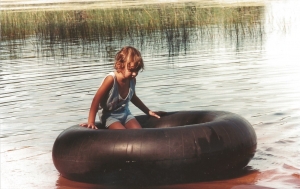
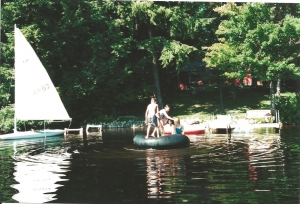
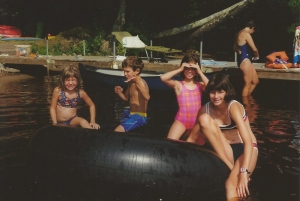
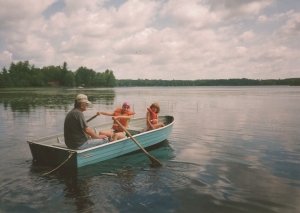
Our single most valuable educational toy was an old inner tube tractor tire that taught 6 valuable lessons and helped raise kids on Summit Lake. Like my siblings and me, my children and their cousins drifted through every stage of childhood floating on that old black tube. Society keeps inventing more high-powered vehicles and electronic toys, but what kids really need is non-motorized, unstructured downtime to be bored and learn how to play.

Kids need non-micro managed moments to be kids. To sky gaze. To float. To doze. To drift. To dream.

That patched up piece of rubber provided endless hours of entertainment. It kept us adrift through the stormy waters of life by creating happy memories to sustain us during hard times. We passed on the art of living in the moment from one generation to the next.

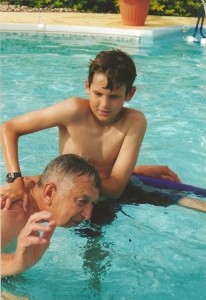
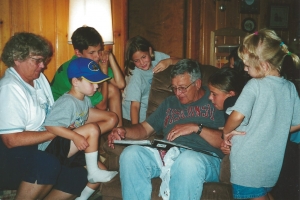
On the water, we learned to share and take turns, balance and agility, team building and muscle making. Off the water that old tube taught us to slow down, relax, and savor stories. While grandma read a fairytales or grandpa recounted sagas of the Summit Lake ghost, kids perched on the side of the tube and learned to love stories.

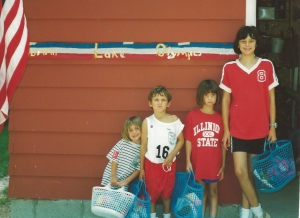
Creativity. That old tire sparked their imagination. They once invented a new sport, Tubastics, which consisted of bouncing on a tube in the yard and jumping up off in perfect 10 point landing. That event inspired their first Summit Lake Olympics complete with an opening parade, special events, posters, prizes, and spectators.

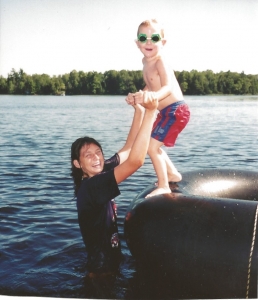
Courage. Younger kids learned bravery by holding hands of an older cousin and jumping off the side of the tube into the dark, cold water.

Leadership. Older kids learned responsibilities by helping younger ones learn to jump, swim, and dive.

Balance. In a sequence of challenges, they tested their dexterity.

  • First step – standing alone on the tube.
  • Next test – balancing upright holding hands with a partner.
  • Add another cousin.
  • Plus a friend.
  • Grand finale – a big splash as the lake echoed with laughter.

As teens and young adults, their games required more skill. Pass and catch while standing on tube became a favorite. Then pass and catch in air while jumping off the tube was added to the repertoire.

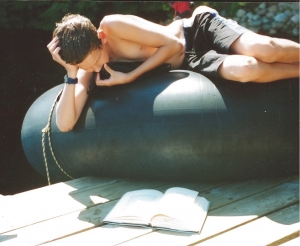
Love of books. On windy days, when the tube absorbed heat from the sun it was warmest spot on the dock and perfect place to read. From Bernstein Bears, to Death on the Nile, from Harry Potter, to Lord of the Rings. Minds enlarged with one mystery after another. Story after story.

Peace of mind. Kids float through summers chilling out in quiet moments of stillness on a silvery lake that rocks in a crib of evergreen under powder blue skies.

Children grew up daydreaming about the doctors, nurses, teachers, engineers, coaches, and counselors and high-spirited, nature loving, compassionate adults they would one day become. Every summer we drift back in time releasing that inner child in a state of mindfulness.

Yep, blissed out on that black inner tube.

Happy 4th of July!

Happy Father’s Day Man with Heart

Though a pacemaker helps your heart keep its beat, we know it needs no assistance in applying its love to being the generous, patient, empathetic, thoughtful, guiding, tolerant, worn out ol’ heart we call DAD. Even as your once strong stride has slowed somewhat, you continue to be an energetic guide through troubled times.

Generous. Your giving heart helped finance college education and provided emergency loans that were forgotten. You helped pay for trips – trains, planes, and automobiles – and seemed to have an endless supply of those $20 bills you referred to as “gas money.” Each year, you took the money you got back from your savings and reinvested it into your grandchildren’s savings. And then there were the presents. A cowboy hat, Barbie doll, microscope, basketball, bicycle… You derived greater pleasure in satisfying others’ material desires than your own minimal ones.

Your greatest gift, though, was time. Taking the time to make sure children grew up feeling loved; not just your children, but all children whose path stumbled across yours. You pitched whiffle balls to the whole neighborhood, rebounded basketballs for the entire team, providing support and counsel to students and players alike who didn’t always have another source for it. You welcomed friends to our cabin every summer and ignored the obvious logistical inefficiency of having to ferry them back and forth separately throughout the summer. In fact, you shuttled kids around until we were old enough to drive, at which point you simply taught us to do it for ourselves.

Patient. You spent hours perfecting our jump shot and bit your tongue to keep from yelling at noisy, teenage girls’ « slumber-less » parties in your basement.
When a student cried in practice or acted up in class, instead of cajoling or scolding you listened, easing the pain for generations of adolescents who discovered one adult they could trust.
You read the same storybook to a demanding 4-year-old granddaughter and balanced the same checkbook for an even more demanding 94-year-old father.

Empathetic. You captured emotions and moments of natural stillness in your paintings and then gave them away so that family could be surrounded by elegant reminders of your love.
You’d peek in at your daughters’ tearful talks behind closed doors, asking, « everything okay? »
Your tender heart gives bear hugs, knee pats, neck rubs, and handshakes. Every phone conversation ends with those 3 endearing words, « I love you, » so there is never any room for doubt.

Thoughtful. In a time when men never wrote more than their signatures, you drew home made cards, penned letters and mailed hundreds of manila envelopes filled with sports clipping to your daughter overseas.
You bought fun fruits, chocolate kisses, ice cream cones and other favorite treats for grandkids.

Guiding. You walked the talk by setting an example of self-discipline, perseverance and integrity – values you instilled in the young people you taught and coached. You counseled so many students, athletes, and friends of your kids that you became a « Papa Mac » to dozens.
You taught us how to save pennies as children and budget money as adults. You explained how to read maps, make terrariums, catch fish, shoot baskets, and throw curve balls.

Tolerant. You welcomed everyone of every race; nationality and walk of life into your home believing every human being should be treated equally. You showered everyone from janitors, to waitresses, to secretaries with kindness and good cheer. You respected your children’s choices from college and careers to dates and mates.

Loving. You loved unconditionally. You forgave our embarrassing affirmations of self, like when I wore pants to church as a teen and left the country to play a game as an adult.
You accepted without question when one daughter married a foreigner, the other married a Cornhusker, and the last broke off her first engagement. And if one of us decided to marry a divorced, ex con, you would learn to love him too and be there to help with the rehabilitation.

Thirty years ago we almost lost you when you had a heart attack. With exercise and clean living, faith and family, you recovered. Though your heart may be tired, your lungs weak and your legs weary, you keep fighting to get up and put one foot forward. In doing so, you inspire us to keep on a keeping on.

You have a great heart, Dad.

The best.

Hanging Laundry Good for Health

I noticed something missing in America, the clothesline. Hanging clothes outside is great therapy. If more people hung clothes, doctors would be out of business. It’s good for achy muscles, stiff joints and stress related illnesses. Bend, reach, ssstttttretch. Breathe. Inhale, pick up the jeans from the basket, and exhale as you pin garments on the line. Hanging laundry forces you to slow down. It’s mindless, which gives you time to focus on the world around you.

As I hang laundry in my little yard in Switzerland, I admire Mont Blanc, a white peak sticking up above a jagged, gray mountain line, behind a shimmering blue lake. Granted not everyone has a view of the Alps, but no matter where one lives, there is beauty to behold – yellow daffodils, emerald lawns, pink cherry blossoms.

I keep old-fashioned wooden clothes pins in a pin bag loving stitched by my mom. Although my son never used pins; he had his own technique. He would fling clothes from the washer directly on to the line. On windy days, I used to pick up my boys’ boxers from my neighbors’ yards on my walk home from school.

I’ve never owned clothes dryer. In Europe, they used to cost a small fortune. They are so tiny, a pair of socks, two t-shirts and three boxers would fill them. Washing machines, also compact, make laundry a daily chore, but it keeps me fit. I haul clothes up and down 24 stairs from the bedrooms to the basement. So my FitBit is always happy.

Every time I do laundry, I think how lucky I am now. When I first moved abroad, I washed clothes in the bathtub on my hands and knees. Then I hung tops, shorts, and socks on furniture to dry.

When first married and living in Paris, my sweat suits waltzed on the wrought iron railing from my balcony overlooking the town square. After our daughter was born baby clothes hung from a rack above the tub. Onesies fell on my head every time I took a bath.

I had been married 15 years before I owned a clothesline and a yard to put it in. Now I have one of those lines that spin and I love watching pants and shirts twirl in the wind. At the end of the day, while folding clothes I enjoy the comforting ritual, seeing the sun slink behind the mountains in a golden glow. While gazing at the view, I daydream unless a family member shows up to help, then we talk. Hanging clothes together helps us stay connected.

Better yet, keeping clothes clean gets me out of the house and away from the kitchen. Some fathers put up Christmas lights in July when they want to get away from the kids, I hung laundry to escape from the daily demands of motherhood.

If they still make clothes lines over in America, you should buy one. It’s a wise investment for your health. You’ll feel better in a couple of days, once you get back into that rhythm. Bend, stretch, breathe. Just what the doctor ordered.

Chiropractors Keep Me Dancing

With the trauma my back has endured, I should be in wheelchair or limping around with a walker, but chiropractors keep me dancing. Forty years ago, when my right leg went numb from my first herniated lumbar disk, a chiropractor saved me from surgery.

Today chiropractic care is recognized as an integral part of the American health system, but back then it was controversial. Doctors were often referred to as quacks.

Historic caged elevator

But after my first visit, I was sold. Chiropractic looks at the body holistically and emphasizes the patients’ role in recovery by promoting exercise, nutrition and healthy lifestyles.

I have been chiro chasing around the globe ever since. Though the treatments may be similar, the settings are not and each chiropractor’s office reflects the unique personality of the practitioner.

In Geneva, I ride a creaky, caged elevator to the 3rd floor of an 18th century building to see Dr. G., a film fanatic. Posters of famous movie scenes cover his walls and his waiting room has an authentic jukebox. While I wait, I boogie down to old hits like Donna Summer’s “Bad Girls,” C’est Chic’s “Le Freak,” and Rose Royce’s “Car Wash.”

My chiro in Eagle River, Dr. D works out of his state of the art stone edifice with cathedral ceilings and gold plated fixtures nestled at the edge of the woods. While enjoying complimentary coffee and cookies from his dad’s bakery you may see deer outside the windows of the waiting room. After an adjustment, chill out literally as you ice down sore spots in comfortable recliners or recharge injured

Chillin with dad at Dr. D’s

body parts with electronic muscle stimulation.

My latest great find, Dr. A, has a family practice in Minnetonka. I thought that meant that he treats families, which he does including babies for free, but it may also mean his family is part of the therapy. His baby and pets accompany him to the office.

His place is like an amusement park. While waiting, you can play pass the baby and pet the dog. No sitting around bored waiting on back breaking straight chairs. Before a treatment, enjoy a free massage on a roller bed or take wild ride on a whoopee seat.

Ever so cheerful, Dr. A sings while he works on you. After my last adjustment, I asked what I should do to help it hold, he said, “Go home. Relax. Put your feet up. Drink a G & T.”

I laughed so hard I rolled off the table.

Convivial. Holistic. Optimistic. Chiropractors are lifesavers.

They make everyone believe – You should be dancing!

YouTube player

FitBit – Tamagotchi for Adults


When our kids gave us a FitBit for Christmas, I had no clue what it was, but FitBit is like a Tamagotchi for adults. Remember those digital pets we babysat for our kids in the 90s? Well, FitbBit vibrates if you haven’t moved your butt in the past 30 minutes. A message flashes across the screen, “Wanna stroll?” And if you forget to feed FitBit with daily motion it will die. When I realized FitBit was another electronic gadget I was mortified because I am techno impaired. Alas, ze Frenchman to the rescue. Sure enough, he programmed that little wristband do everything except cook dinner.

Tamagotchi

For those not in the know, FitBit is a physical activity tracker designed to help you become more active,eat a more well-rounded diet, sleep better and live healthier. Or at the very the least, it can make you a more obsessive human being.

FitBit records time, measures motion, counts calories, steps, and stairs. It records pulse, tracks sleep, and differentiates between biking, hiking, skiing, climbing, strolling, and running.

FitBit data can be synced to an online account. You can track every breathing moment even while sleeping. Which may not be a good thing. Over morning coffee ze Frenchman checks my profile and scolds me, “Pot you did not sleep well. Only 4 hours and 18 minutes.”

“I know,” I grumbled. “Why do you think I wake up feeling like I’ve been run over by truck?”

For many FitBit is a great motivator. It collates data about your weekly fitness level and sends you virtual badges rewarding positive behavior.

London Underground Badge: You’ve walked 250 miles—as many as the world’s first underground railway.

My Frenchman, who is 62 going on 16, is really taken with it. Since retiring he never stops moving. He plays volleyball, lifts weights, skis, bikes, hikes and kayaks. With my bad feet, bad knees, and a bad back, I limp along a mile behind him.

“I am struggling to keep up with your dad,” I confessed to our daughter.

“Somebody needs to remind him he is retired.”

Good luck with that,” I said. “Your dad used to time his sisters when they walked to school. Now if FitBit shows we are not moving fast enough, he yells at me to hurry up.”

“Mom, what have we done?” Nat lamented, “FitBit will be the death of you.”

Ah, but for an old athlete I can’t think of any better way to go… on the move breaking records.