
 Awe-struck by the sight of the colorful, long house boats, I peppered the people floating past with questions. Friendly folks answered all of my silly inquiries.
‘One guy, Pete, even offered to let me ride through the lock with him. I hopped aboard and sat on a tractor seat in the stern where he guided the boat with a tiller. As we went through the lock, I waved like the queen to the boaters on the shoreline waiting their turn to go through the locks.
After we went through the lock, Pete suggested, “Fancy a walk-through tour?”
His 11-year-old son, Alfie led me through the narrow galley of their boat that reminded me of a skinny RV without the wheels.
 The average 7 foot by 50 foot narrow boat has about 350 square feet of space for a bedroom, kitchen, living area, toilet, and cockpit. A small refrigerator, stove, cupboards and a narrow table squeezed on one side of the boat. Most have electric heat or a wood burning stove.
In the mid section, Alfie proudly showed a lounge area. His comic books were scattered on the coffee table along with checker board.
 “Me ’n dad sleep on the couch that folds out into a bed right in front the telly,” he added. “Granddad sleeps in the bow and this here is the toilet and shower.”
Unlike most, their boat had the luxury of two bathrooms, one in the bow and another in stern. Across the narrow walkway was a built in washing machine.
“We’ve been with my grandparents for three weeks of holiday. Wish I could live on the boat forever,” Alfie told me, “except when granny yells at me for sitting on the roof! She’s afraid I’ll fall through.”
When the canal transport of goods was replaced by trains, holiday makers began renting 'narrowboats' and roaming the canals, visiting towns and villages they passed. Waterside pubs and village shops cater to boaters. Most towns along canals have free moorings that can be used for 1 to 2 days. Boaters lasso mooring posts along the canal side with heavy braided ropes. Then they hop off and head to the nearest pub.
 Much like the English cottages in the village, each boat on the canal has its own name and unique identity with eclectic collections of artifacts, various potted plants and flower boxes decorating their colorful painted exteriors with names like Athena, Beulah Mae, Lady Anne, Jemima, Tubby Bunny, Rollin Along, Bubbling Billy, End and Beginning
Trying to decipher the lingo of canal boaters is like learning a foreign language. References include: Back pumping. Blow - a warning of  collision. Bow, or fore end. Deck. Fore and aft.
Cruising the canal can be enjoyed by all ages and “boat” people were an eclectic groups of families, retirees, free spirits and throwback hippies
For some canal boat living has become a way of life. Getting back to nature and rural living, riding the canal is a great escape from our frantic modern-day pace and offers slower way of life that everyone envies at times.
For more information follow adventures of The Rum Wench vlog here

 I climbed into the steel reinforced bunkers overlooking the Normandy landing beaches on Pointe du Hoc eighty years after the Rangers overtook the strategic German lookout 90 feet above the English Channel. I pictured a 19-year-old American boy jumping out of a PT boat into icy waters, with nothing more than a gauze bandage for comfort on a stormy dawn illuminated by gunfire.


 From the window of our son and daughter-in-law’s home in Warwickshire, England, I was admiring the red, brick barns and lush, green fields when suddenly a head floated past, just above their back hedge.
 century. In the past, a boy riding a bicycle prepared or set locks ahead of a boat's arrival. Nowadays, the woman aboard, carrying the lock key, hopped off onto shore to open the gate letting the water rise or fall, while the mister stood at the stern manning the rudder bar.
 Revolution, the canals system provided a commercial transport network until the the railways prevailed.
 Only a sunny day, a carnival atmosphere prevails. I felt wistful watching the colorful boats parade past on the lazy canal. Whimsically, I imagined ditching real life and drifting down the canal without a care in the world.
 I was excited as a two-year-old to take my first walk in wellies across the beautiful British countryside (I am easily amused.) Wellies, the symbol of British culture, reflect the lasting legacy of the Duke of Wellington and the term carries a sense of tradition, practicality, and British identity.
 The British waterproof gumboots are usually made from rubber or PVC. Traditionally Wellies come in black, olive green, tan color or print and hit just below knee level.
 Today's wellies, with varied color options and patterns, permit people to add personal style to functional footwear. They can be paired to match every outfit and occasion.
 I don’t have a regular post this week, but I have been working on an issue that weighs heavy on my heart and is important for everyone.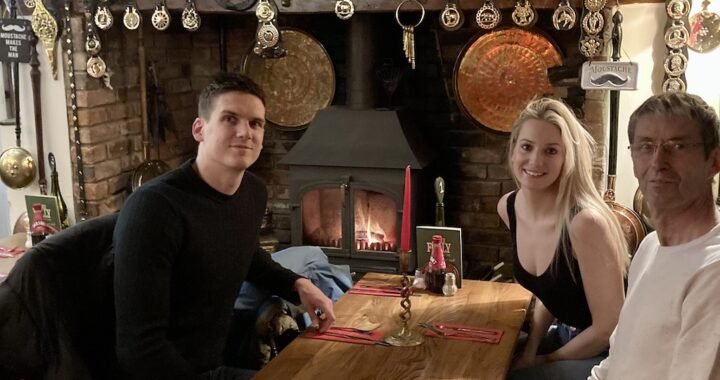
 When my son married a beautiful British-Irish-Ukrainian woman, we were given an insiders peek into UK life, which begins and ends at the local pub. Going to the pub for a pint is as much a part of British life as a coca cola and Friday night football is to an American.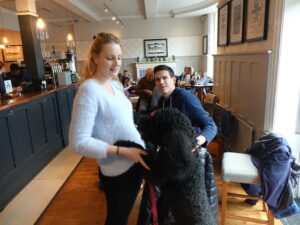
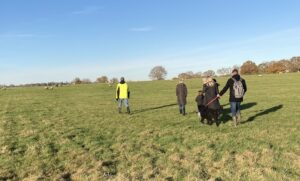 “I don’t see any signs allowing us to hike on their property,” I said.
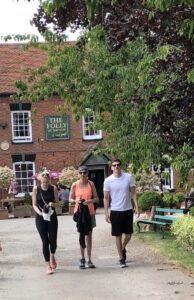 “A phone app indicates where it is okay to go,” said Larissa. “But it’s mostly common sense. You wouldn’t walk through field of donkeys or free range horses. It’s at your own risk if you try to cross a field of buffalo.”
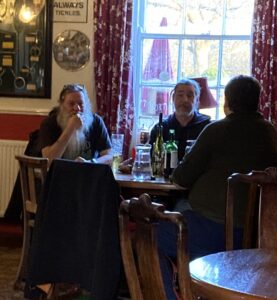 drinks, after our hike, we were so thirsty, we opted for cokes, beer, and the local cider. The little boys sat politely at the table enjoying snacks.